
Couchbase vs. MongoDB™: Performance & Scalability Compared
Why businesses are switching from MongoDB to Couchbase – discover the advantages.
FEATURES
Key features of Couchbase vs. MongoDB


Code Snippet
Comparison of equivalent queries in Couchbase SQL++ and MongoDB’s MQL
/* equivalent to the Mongo example */
SELECT SUM(value * volume) AS val, symbol
FROM   db.stocks
WHERE  symbol IN ( "AAPL", "GOOG" ) AND value > 0
GROUP  BY symbol
ORDER BY val DESC, symbol ASC// equivalent to the SQL++ example
db.stocks.aggregate([
{ "$match": {
"$and": [
{"symbol": {
"$in": [
"AAPL",
"GOOG"]}},
{ "value": {
"$gt": 0 }}]}},
{ "$group": {
"_id": {
"symbol": "$symbol" },
"sum(value * volume)": {
"$sum": {
"$multiply": [
"$value",
"$volume"]}}}},
{ "$project": {
"_id": 0,
"sum(value * volume)": "$sum(value * volume)",
"symbol": "$_id.symbol"}}
{ "$sort": {
"sum(value * volume)": -1,
"symbol": 1 }}]})CUSTOMERS
What customers are saying







“We see very consistent 500 microsecond response times from Couchbase even at very large scale.”
, Technical Lead, Cisco
100B+
user sessions per year
500
microsecond response times

“We found that the replication technology across data centers for Couchbase was superior, especially for large workloads.”
Claus Moldt, CIO, FICO
<1
ms response times
24×365
application uptime

“With less than half the servers, we can increase performance and gain a much better scalable architecture.”
Amir Ish-Shalom, Sr. Director of Operations, Viber
15
billion call and message events/day
60%
reduction in total servers
Resources
Learn more about how Couchbase compares to MongoDB
-

WHITEPAPER
Couchbase Capella vs. MongoDB Atlas – Altoros benchmark study
-

BLOG
Couchbase is 350x faster at vector search than MongoDB at 1B scale
-

VIDEO
Migrating from MongoDB Atlas Device Sync to Couchbase Mobile
FAQ
Couchbase vs. MongoDB FAQ
Get quick answers about how Couchbase and MongoDB compare in terms of performance, scalability, and more.
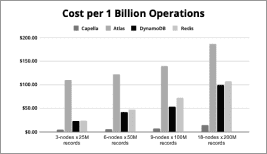
Couchbase outperforms MongoDB on throughput and latency in independent benchmarks, including YCSB testing, due to its memory-first architecture and built-in caching layer.
Couchbase Hyperscale Vector Index achieves 700+ QPS at billion-vector scale. MongoDB Atlas returned 2 QPS with 40-second latency in the same VectorDBBench test conditions.
Couchbase uses SQL++, a superset of SQL that supports JOINs, aggregations, and complex queries on JSON. MongoDB uses a proprietary query language with no native JOIN support.
Couchbase typically delivers lower TCO than MongoDB through built-in caching, fewer required add-ons, and more efficient cluster sizing, reducing infrastructure and licensing costs.
Yes. Couchbase includes Couchbase Lite and Capella App Services for offline-first mobile and edge apps. MongoDB deprecated Atlas Device Sync in 2024, leaving mobile users without a replacement.