
What is data integration?
Data integration is the process of combining data from various sources into a single, unified view. It focuses on the movement and transformation of data itself. The primary goal is to create a consistent and accessible pool of information for analysis, reporting, and business intelligence (BI). Imagine that all your company’s information – customer details from your CRM, sales figures from your e-commerce platform, and supply chain metrics from your ERP – is consolidated in one central location, like a data warehouse or data lake. This consolidation makes it possible to get a holistic view of business operations, identify trends, and make better-informed decisions.
What is application integration?
Application integration, on the other hand, focuses on making independent software applications communicate and work together in real time. It’s about connecting applications at a functional level to ensure they operate as a cohesive unit. Instead of just moving data, it enables different applications to trigger actions and share functionalities across systems. For example, when a new lead is added to your marketing automation platform, application integration can automatically create a corresponding contact in your CRM and notify a sales representative via a messaging app. The goal is to streamline business processes, automate workflows, and create a seamless operational flow across different departments and functions.
How data integration works
Data integration typically involves the multistep process of ETL (extract, transform, load) or ELT (extract, load, transform).
- Extract: Data is pulled from its original source systems. These sources can be diverse, and include databases, spreadsheets, cloud applications, and flat files.
- Transform: Once extracted, data is cleaned, standardized, and restructured to conform to the target system’s format. This step is critical for ensuring data quality and consistency. It may involve converting data types, validating information, removing duplicates, and aggregating records.
- Load: The transformed data is loaded into a central repository, such as a data warehouse or data lake.
In an ELT process, the raw data is loaded into the target system first and then transformed within that environment. This approach is common in modern cloud-based data architectures. Data integration is often performed in batches, such as on a daily or weekly schedule, though near-real-time options are becoming more common.
How application integration works
Application integration relies on connectors and APIs (application programming interfaces) to enable communication between software systems. An API acts as a messenger, defining the rules and protocols for how different applications can request and exchange information.
When an event occurs in one application (e.g., an invoice is paid), an API call is triggered. This call sends a message to another application, instructing it to perform a specific action (e.g., update the customer’s account status in the billing system).
This process happens in real time or near real time, enabling immediate process automation. Unlike data integration, which moves large volumes of data for analytical purposes, application integration facilitates transactional, function-to-function communication to keep business processes running smoothly.
Differences between data integration vs. application integration
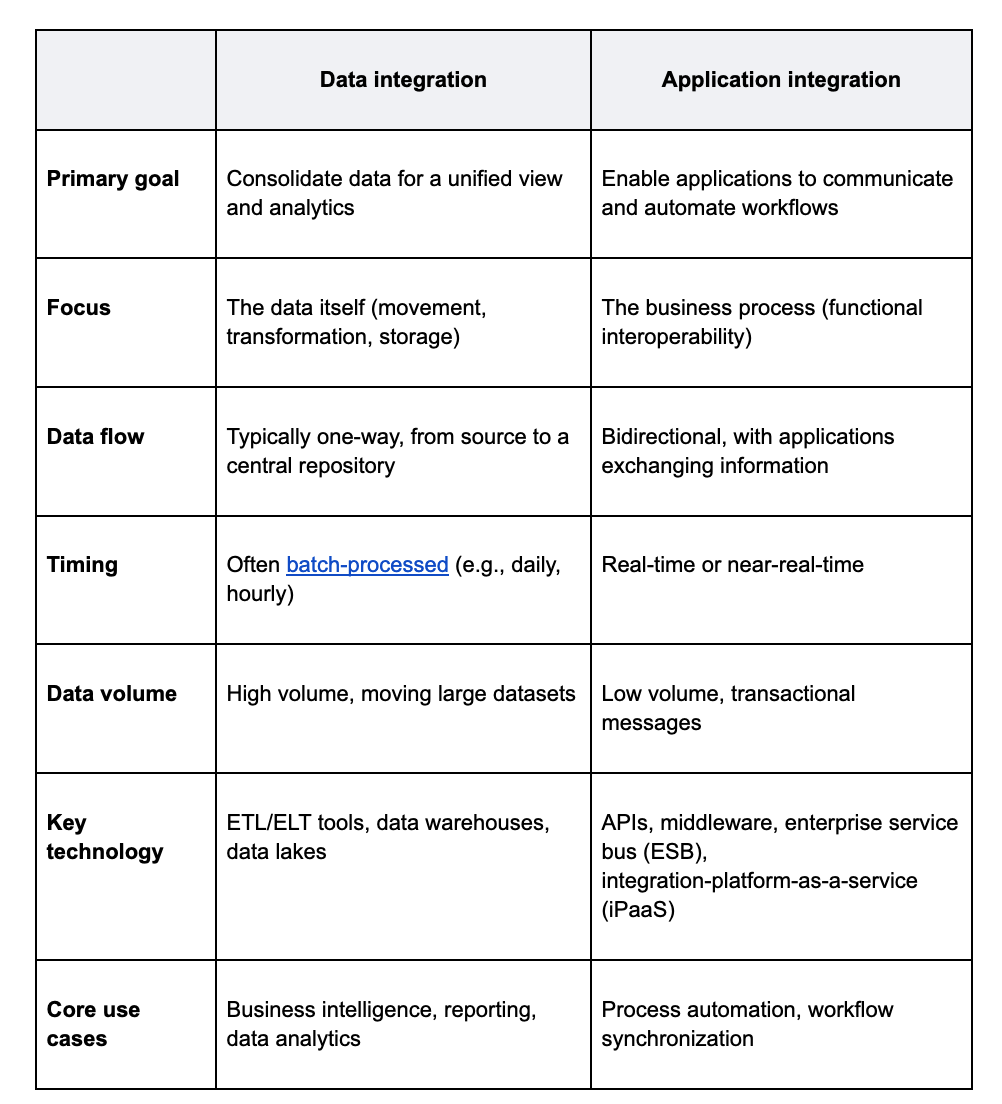
While both types of integration involve connecting systems, their purposes, scopes, and methods are distinct, as shown in this comparison table:
Data integration benefits and challenges
Benefits
- Improved decision-making: By providing a single source of truth, data integration empowers leaders with comprehensive insights for strategic planning.
- Enhanced data quality: The transformation process cleanses and standardizes data, reducing errors and inconsistencies.
- Greater efficiency: Analysts and data scientists spend less time gathering data and more time analyzing it.
- Holistic business view: Data integration breaks down data silos, offering a complete picture of customers, operations, and performance.
Challenges
- Complexity: Integrating data from numerous varied sources can be technically challenging and resource intensive.
- High initial cost: Setting up data integration infrastructure, including data warehouses and ETL tools, requires significant upfront investment.
- Maintenance: Data sources and business requirements change, necessitating ongoing maintenance and updates to integration workflows.
- Data governance: Managing data security, privacy, and compliance across multiple sources adds a layer of complexity.
Application integration benefits and challenges
Benefits
- Increased productivity: Automating manual tasks across applications frees up employees to focus on strategic work that adds more value.
- Streamlined operations: Application integration creates seamless workflows, reducing delays and improving process efficiency.
- Enhanced customer experience: Integrating customer-facing systems ensures consistent and timely service.
- Greater agility: Businesses can quickly connect new SaaS applications and adapt processes to changing market needs.
Challenges
- API limitations: Integration is dependent on the quality and availability of the applications’ APIs. Some legacy systems lack modern APIs.
- Complexity at scale: Managing a large number of point-to-point integrations can become a “spaghetti architecture” that’s difficult to maintain.
- Security risks: Each connected application introduces a potential vulnerability. Proper security measures are essential to protect data in transit.
- Dependency on vendors: Changes to a third-party application’s API can break integrations, requiring prompt attention and updates.
Data integration tools
These tools are designed to handle large-scale data movement and transformation. Common examples include:
- ETL tools: Fivetran, Stitch, Talend, and Informatica PowerCenter specialize in extracting, transforming, and loading data into warehouses.
- Cloud-native solutions: AWS Glue, Google Cloud Data Fusion, and Azure Data Factory offer scalable integration services for major cloud ecosystems.
- Data lake platforms: Databricks and Snowflake provide unified platforms that combine data storage with powerful integration and transformation capabilities.
Application integration tools
These platforms focus on API-led connectivity and workflow automation.
- iPaaS: MuleSoft Anypoint Platform, Boomi, Workato, and Zapier provide cloud-based platforms with prebuilt connectors and visual workflow builders to connect applications.
- ESB: Traditional on-premises solutions like TIBCO BusinessWorks and IBM App Connect Enterprise act as central hubs for routing messages between applications.
- API management platforms: Apigee (Google), Kong, and Amazon API Gateway help organizations design, secure, and manage their APIs.
When to use data integration vs. application integration
Choosing the right approach depends entirely on your business goal.
Use data integration when you need to:
- Build a central repository for business intelligence and analytics
- Consolidate historical data from multiple systems for trend analysis
- Prepare datasets for machine learning models
- Create a 360-degree view of your customers by combining data from sales, marketing, and support systems
Use application integration when you need to:
- Automate a business process that spans multiple applications
- Synchronize data between two systems in real time (e.g., syncing inventory between your e-commerce site and ERP)
- Create a seamless user experience by connecting different services
- Enable different departments to work collaboratively within their preferred applications
Key takeaways and related resources
Data integration and application integration are not mutually exclusive; they are complementary disciplines that solve different business problems. Data integration provides the consolidated information needed for strategic insight, while application integration drives the operational efficiency needed for day-to-day execution. A comprehensive integration strategy often uses both to create a truly connected enterprise.
By understanding the unique functions and benefits of both types of integration, you can select the right tools and methods to break down silos, automate processes, and unlock the full value of your technology stack.
To learn more about topics related to data management, you can visit the related resources below:
Related resources
- What Is a Data Platform? – Concepts
- Data Ingestion – Concepts
- 5 Reasons to Use Molo17 GlueSync for Data Integration – Blog
- Real-Time Databases – Concepts
- A Guide to AI Data Management – Blog
- Couchbase Capella on Google Cloud – Partners
FAQs
Can an organization use both data and application integration together? Absolutely. In fact, most modern enterprises need both. For example, a company might use application integration to sync a new sale from its e-commerce platform to its CRM in real time. It might then use data integration to pull daily sales data from both systems into a data warehouse for historical sales performance analysis.
What are the four types of application integration? The four main types are:
- API integration: Using APIs to expose and consume data and functionality between applications
- Method integration: Allowing different applications to call procedures or methods from one another
- Data-level integration: Directly sharing databases or files, though this is an older and less flexible approach
- User interface (UI) integration: Combining multiple application front-ends into a single, unified user interface, often through a portal
Is data integration or application integration better for real-time data sharing? Application integration is better for real-time data sharing. It’s designed for immediate event-driven communication between systems to keep processes synchronized. Data integration is typically done in batches and is better suited for periodic, large-volume data updates for analytics.
Is data integration or application integration better for cloud-based systems? Both have excellent solutions for cloud-based systems. Application integration thrives in the cloud through iPaaS platforms, which are built to connect SaaS applications. Data integration uses cloud data warehouses (like Snowflake or BigQuery) and cloud-native ETL/ELT tools (like AWS Glue or Azure Data Factory) for scalable, flexible data consolidation.
How does data integration improve business analytics? Data integration directly enables and improves business analytics by providing clean, consolidated, and reliable datasets. It eliminates data silos, ensuring analysts have access to all relevant information from across the business. This comprehensive view leads to more accurate reports, deeper insights, and better predictive models.
How do data security and governance differ between data and application integration? In data integration, security and governance focus on protecting the centralized data repository (the “data at rest”). This involves access controls, encryption, and data masking within the data warehouse or lake, as well as ensuring compliance with regulations like GDPR.
In application integration, the focus is on securing the data in transit between applications. This involves API security, authentication (e.g., OAuth), message encryption, and access token management to prevent unauthorized actions. Governance is about managing the lifecycle of APIs and ensuring they are used correctly.


