THE DATA LAYER FOR YOUR AGENTIC WORKFORCE
Couchbase AI Data Plane™
Give your agentic workforce memory, governed access to live business data, and an auditable record of what it did, all on the operational data that already runs your business.

Agents stall before production
Most agent programs don’t fail on the model. They fail on the data layer underneath, and it shows up in four places.

Agents forget
Context lives apart from the operational record, so agents start cold, ask the customer again, or fill the gap themselves.

Agents can’t reach the business
Every agent needs its own integration to touch live data, so the tenth one takes just as long to build as the first.

Agents can’t account for themselves
Prompts, tools, traces, and the records an agent read sit in separate systems, so nobody can say what actually happened.

Token cost explosion
Without persistent memory, applications resend the whole conversation every turn and pay again for context already stored.
What is the AI Data Plane?
One governed layer where agents remember, reach live business data through a standard interface, and leave a record you can query.
Agent Memory holds short-term session state and long-term profile and semantic memory across sessions, restarts, users, and frameworks. TTL decay retires stale context on its own, and timestamp-based conflict resolution keeps the record straight. Run it fully managed on Capella or self-managed in your own data center.
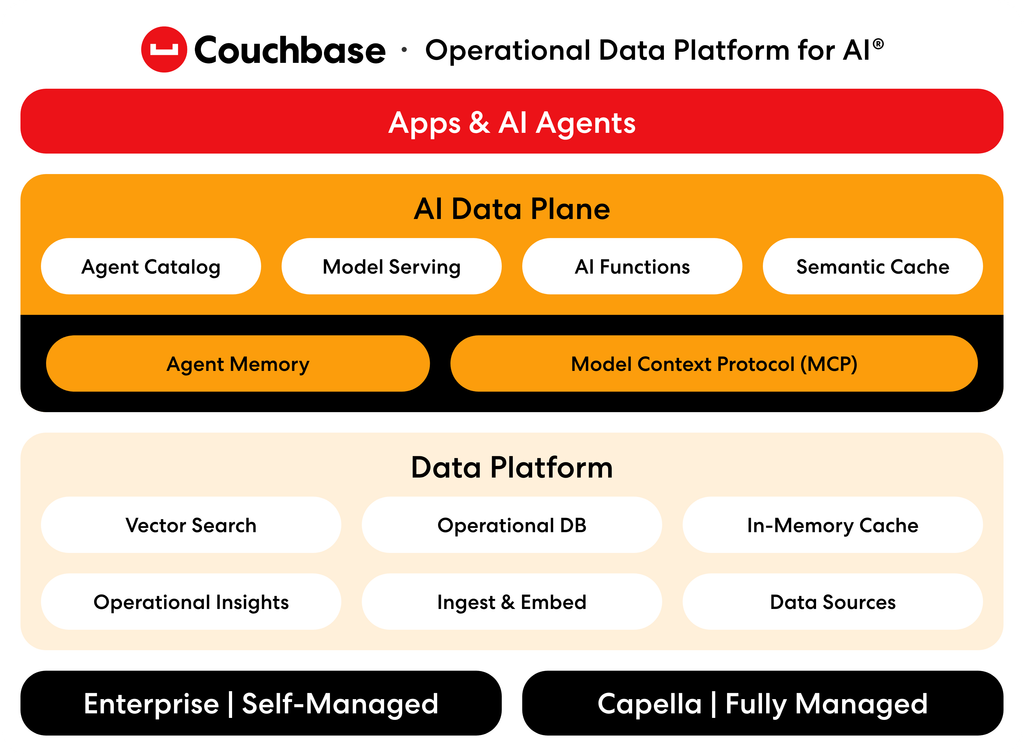
The Couchbase MCP Server gives every agent one standard, governed way to reach live business data. Model Context Protocol is the interface the agent ecosystem is standardizing on, so tool access is authorized and logged in one place instead of hand-coded per agent. Available in managed or self-hosted deployments.
Vector, full-text, and SQL++ predicates resolve in a single query path against the operational record itself, not a synchronized copy with its own freshness window. Three vector index types cover billion-scale search and highly selective filtered search, so answers come from current data.
Agent Catalog stores prompts, tool definitions, and end-to-end traces as data, next to the records an agent actually read. One SQL++ query answers which agent did what, for which user, on which prompt version, reading which records. Audit becomes a query instead of a reconstruction project.
Persistent memory replaces resending conversation history every turn, so token spend stops tracking agent activity. Exact and semantic caching answers repeated prompts without a new model call, and memory-first reads keep the path fast when one user turn becomes a dozen machine requests.
Benchmarked on public evals
1B+ Scale
Vector storage and search across three index types
82.3%
on LoCoMo Eval benchmark
CUSTOMER PROOF
AI in production on Couchbase


HOW IT WORKS
Agentic workflow, one governed layer
Every step an agent takes runs against the same governed data layer, with no hop to a separate tier between the work and the data.
- Plan
- Retrieve
- Reason
- Act
- Remember
Break the goal into steps and select which tools and data to call.
Capabilities on one platform
MCP Server
Governed, standardized agent access to operational data, as a managed service or self-hosted.
Agent Catalog
Prompts, tools, and end-to-end traces stored as data and queryable in SQL.
Gather live operational data and knowledge to ground the next step.
Capabilities on one platform
Hybrid Search
Vector, full-text, and SQL in one query for the most accurate contextual results.
In-Memory Cache
Sub-millisecond reads, no separate cache tier.
Call the model to plan, decide, and generate many times per ask.
Capabilities on one platform
Semantic Cache
Answers repeated and similar prompts without a new LLM call.
Model Service
Serverless frontier models billed by the token, or dedicated GPU inference inside your own perimeter.
Agent Catalog
Prompts, tools, and end-to-end traces stored as data and queryable in SQL.
Execute tools, commit results, and trigger downstream workflows.
Capabilities on one platform
MCP Server
Governed, standardized agent access to operational data, as a managed service or self-hosted.
Eventing & Functions
Server-side JavaScript that reacts to data changes in real time, no app code required.
Persist context across sessions, restarts, users, and frameworks.
Capabilities on one platform
Agent Memory
Persistent memory across sessions, restarts, and frameworks, fully managed on Capella or self-managed in your own data center.
Ingest & Embed
Captures every data change and streams it to downstream systems in real time.
Operational Insights
Real-time analysis in place, now with vector search.
- Agent Memory
- MCP Server
- Bedrock integration
ARCHITECTURE
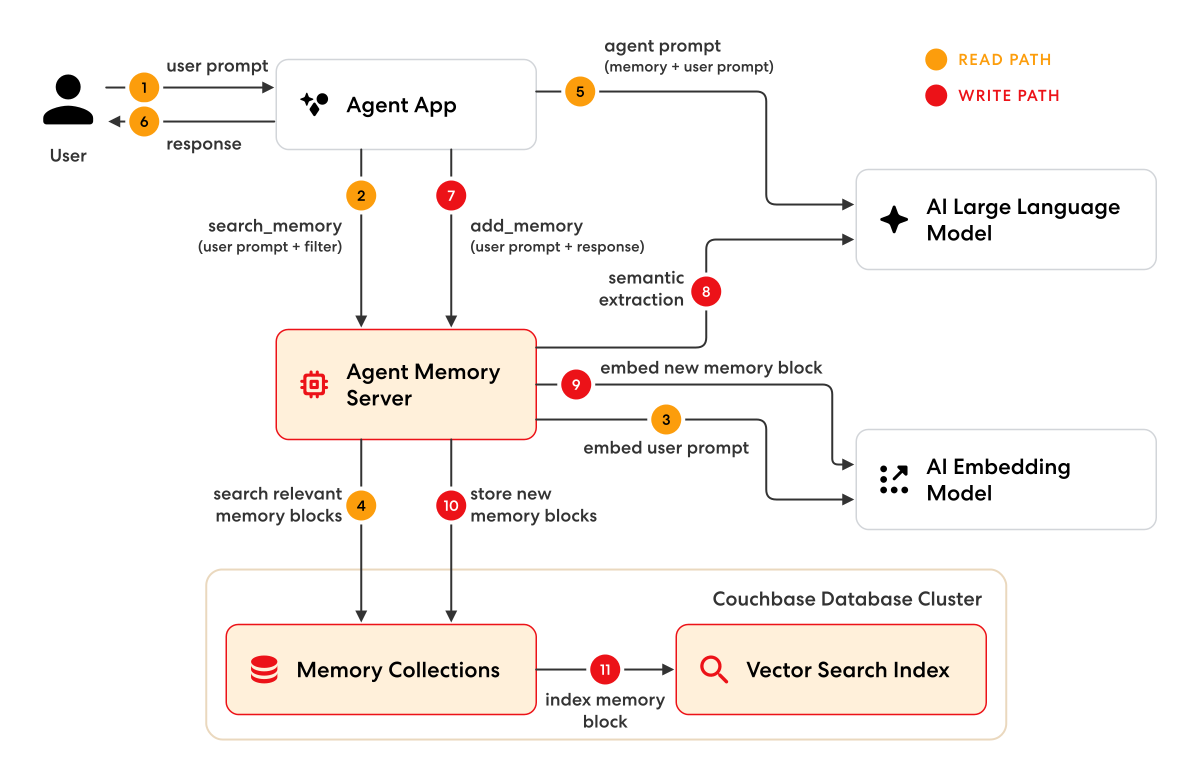
How Agent Memory is processed
Short & long-term memory
Manage active sessions (short-term) while persisting facts, profiles, and summaries across sessions (long-term), through a single API.
Security & governance
Per-user memory isolation pairs with OIDC/OAuth2 authentication. Memory access is traceable through Agent Tracer for audit and debugging.
Memory freshness & time travel
TTL-based decay retires stale context on its own. Immutable memory blocks give you point-in-time retrieval and timestamp-based conflict resolution.
Self-managed or fully managed
Run it yourself on Docker, in any cloud or air-gapped on premises, with validated integrations for LangGraph, CrewAI, LlamaIndex, and Strands. Or run it managed on Capella.
ARCHITECTURE
How agents reach your data
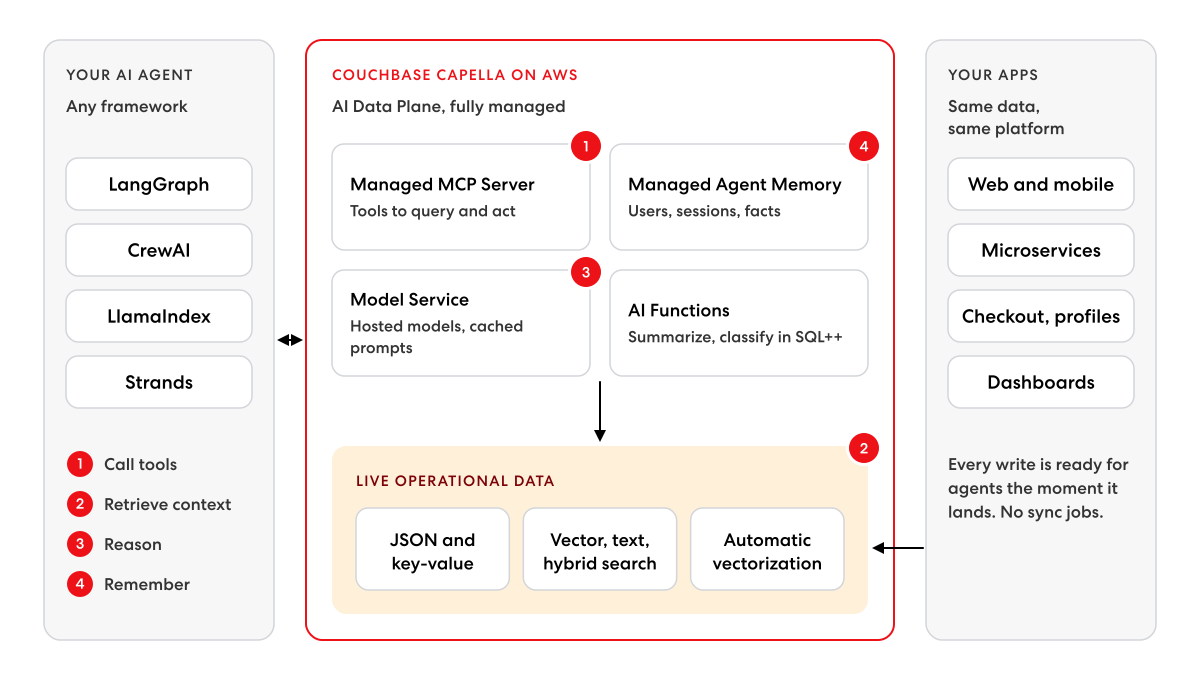
Agents call the Couchbase MCP Server over the open Model Context Protocol and get governed access to operational data, vectors, documents, and cache. Access control stays at the data layer instead of forking across bespoke connectors, and every call is logged.
ARCHITECTURE
How Couchbase works with Bedrock
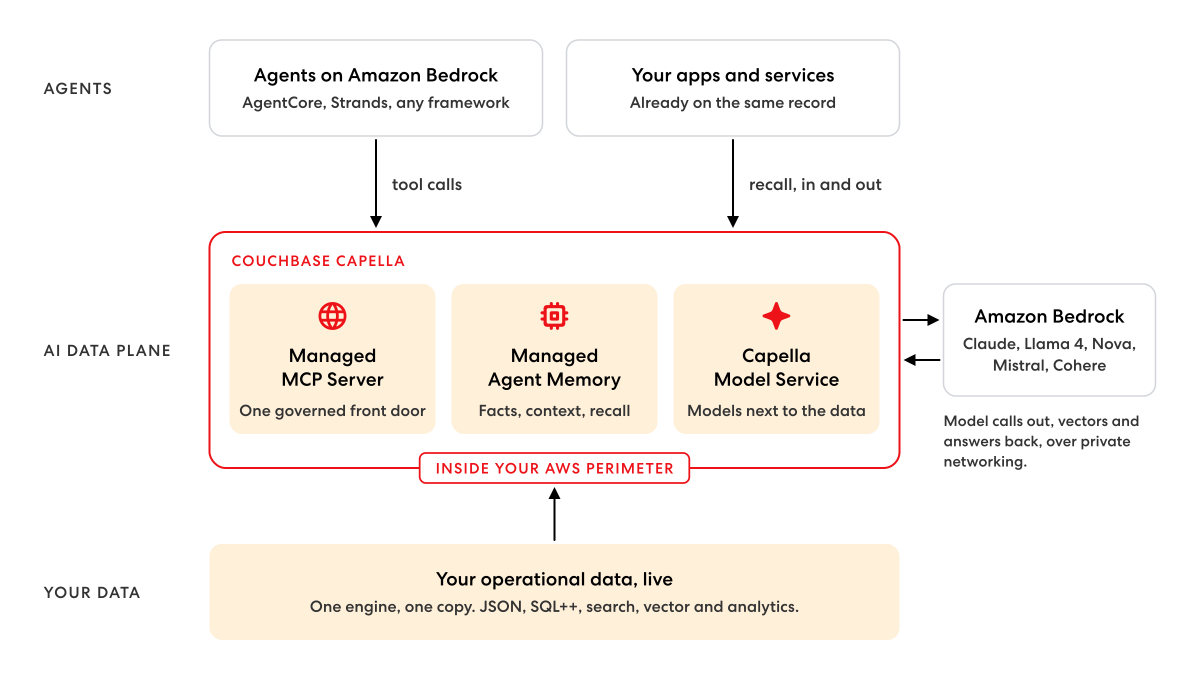
Agents on Amazon Bedrock reach Capella through one governed Managed MCP Server and keep context in Managed Agent Memory. Capella Model Service calls Bedrock models such as Claude, Llama 4, and Nova next to your live data, with embeddings generated over private networking inside your AWS perimeter.
INTEGRATIONS
Ready to plug into your AI ecosystem
Agent Memory is validated with LangGraph, CrewAI, LlamaIndex, and Strands, and reachable over REST for anything else. Model Service calls frontier models through Amazon Bedrock. Partners across data, observability, and infrastructure plug into the same governed layer, so changing one piece of your stack no longer means rebuilding the rest.
Two ways to run the AI Data Plane™
FULLY MANAGED
Couchbase Capella
Agent Memory, MCP Server, Agent Catalog, and Model Service delivered as managed services. Nothing to provision, patch, or scale. Serverless inference bills by the token, embeddings generate over private networking, and the operational data your agents read already lives here.
SELF-MANAGED
Couchbase Server Enterprise Edition
The same AI Data Plane in your own data center, private cloud, or a fully air-gapped site. Agent Memory, Agent Catalog, and the MCP Server run as containers with the same data model, the same APIs, and the same security model, so agents move between deployments without a rewrite.
AI Data Plane (Formerly AI Services) FAQ
Quick answers on agent memory, governed data access, deployment options, caching, and cost.
Couchbase AI Data Plane™ gives production AI agents one governed data layer for memory, context, tools, prompts, traces, cache, and the live operational data that runs the business.
Agent Catalog manages prompt metadata, tool metadata, and end-to-end traces so teams can inspect, reuse, and govern agent behavior across applications.
Agent Memory keeps short-term session state and long-term profile and semantic memory across sessions, restarts, users, and frameworks, stored next to the operational data the agent is working on.
Persistent memory eliminates the need to resend conversation history on every turn, exact and semantic caching avoids repeated model calls, the tool and prompt registry reduces costly incorrect tool calls, and serverless inference charges by the token instead of by reserved GPU capacity.
Couchbase keeps prompts, tools, traces, memory, and operational data in one governed data layer so teams can inspect what agents used and why they responded.
Yes, AI Services has officially rebranded to AI Data Plane as of June 2026. The product has evolved under the AI Data Plane identity to support new features.
Keep exploring
-

Dive deeper into AI Data Plane
Components, architecture, and what runs where, in one datasheet.
-
Billion-scale vector benchmark results
We’re happy to be recognized for our leadership in vector search.
-

Start building today
Talk with Couchbase about a POC to move your agents from pilot to production.