
Multi-Dimensional Scaling
Couchbase Multi-Dimensional Scaling (MDS) improves performance and lowers costs by scaling services independently and avoiding the wasted resources of all-in-one designs.
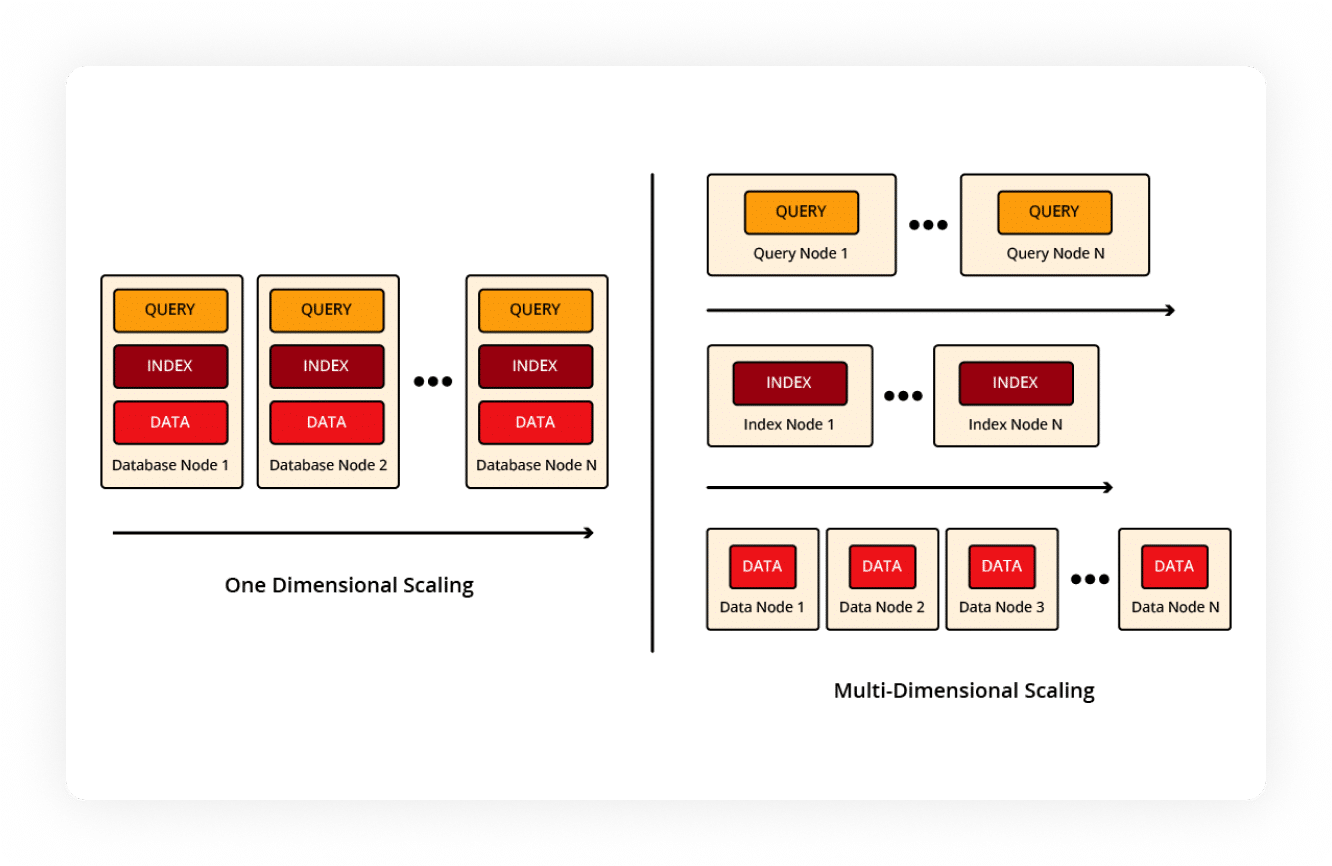

What is multi-dimensional scaling?
Couchbase MDS improves performance and reduces costs by letting you scale your query, index, and data services separately. This separation eliminates resource conflicts, wasted hardware, and unnecessary rebalancing. Plus, you can assign each service to the best hardware for its job – CPUs for queries, SSDs for indexes, and RAM for data. Your apps run faster, customers get a better experience, and your system is easier to manage.
How do database services benefit from isolation?
Fast processors for queries
Queries run faster on dedicated nodes and don’t slow down reads or writes by hogging CPU.
High-performance SSDs
Indexes on dedicated nodes search faster and don’t slow down writes by overloading disk I/O.
Data distribution
More nodes mean more data capacity. With isolated data nodes memory use goes up, CPU/disk needs go down, and read/write speed stays consistent.
Efficiency
Couchbase lets you assign services to specific nodes, maximizing CPU and RAM usage through efficient resource distribution.
Speed without interference
Dedicated query nodes ensure fast processing without slowing down reads or writes. By isolating query operations, you avoid CPU contention with other services, and you can scale query nodes without rebalancing data. This makes queries consistently fast, even under heavy loads.
High-speed lookup, zero bottlenecks
Index services benefit from SSDs and operate best when isolated. This keeps writes fast since disk I/O isn’t shared with other services. You can scale indexing independently and create as many indexes as needed without affecting data distribution or write performance.

Consistent reads and writes at scale
When data nodes are isolated from query and index workloads, reads and writes stay fast and predictable. You don’t have to rebalance queries or indexes to scale the data layer, and you can prioritize memory while using more modest CPU and disk resources.
What customers are saying
-


“Switching to Couchbase increased performance while lowering database and operational costs.”
Jeremy Badong, Program Director, Yondu95%
reduction in update time
20%
reduction in incident reports
-


“What we value a lot is that Couchbase was able to embrace with us our vision to the cloud.”
Vincent Bersin, Unit Manager, NoSQL Solutions, Amadeus20M
operations per second
<2.5ms
response times
Explore related resources
-

Video
Couchbase’s multi-dimensional scaling
-

Docs
Planning for and using multi-dimensional scaling for your cluster
-

Blogs
Latest blogs about MDS