
RESUMO
Agentic retrieval-augmented generation (RAG) extends traditional RAG by adding an autonomous agent that can reason, plan, and take actions to achieve a goal rather than relying on a single retrieval step. Unlike standard systems that follow a fixed workflow, an agentic approach dynamically breaks down complex tasks, performs multiple searches, uses external tools or APIs, and adapts its strategy as new information emerges. This iterative process improves accuracy, reduces hallucinations, and enables more effective handling of ambiguous or multi-step problems. Key components typically include a decision-making agent, structured retrieval across multiple data sources, memory for context, access to tools, and orchestration to manage execution. Because of these capabilities, agentic RAG is well-suited for advanced use cases such as enterprise knowledge assistants, analytics, customer support automation, and research; however, it introduces greater complexity, cost, and infrastructure considerations.
What is agentic RAG?
Agentic RAG is an advanced AI architecture that integrates an autonomous agent with the core components of retrieval-augmented generation. In simple terms, it gives a RAG system the ability to think, plan, and act. Instead of using a single passive retrieval step, an agente actively decides what information it needs, how to get it, and how to use it to achieve a specific goal.
A traditional RAG system takes a user query, retrieves relevant documents from a knowledge base, and uses those documents to generate an answer. An agentic RAG system builds directly on standard RAG, but takes further steps to provide the best answer. An agent, powered by an LLM, examines the user’s goal and creates a plan. This plan might involve making multiple retrieval queries, using different tools (like a calculator or an API), or even asking clarifying questions. The agent orchestrates this entire process, learning and adapting as it gathers more information.
This combination of retrieval, generation, and autonomous decision-making allows the system to handle ambiguity and complexity far more effectively than its predecessors.
Traditional RAG vs. agentic RAG
While both systems aim to provide grounded, factual answers, their methods and capabilities differ significantly. Traditional RAG is excellent for straightforward questions, but agentic RAG excels at tackling complex, multi-faceted problems. Here are some key differences:
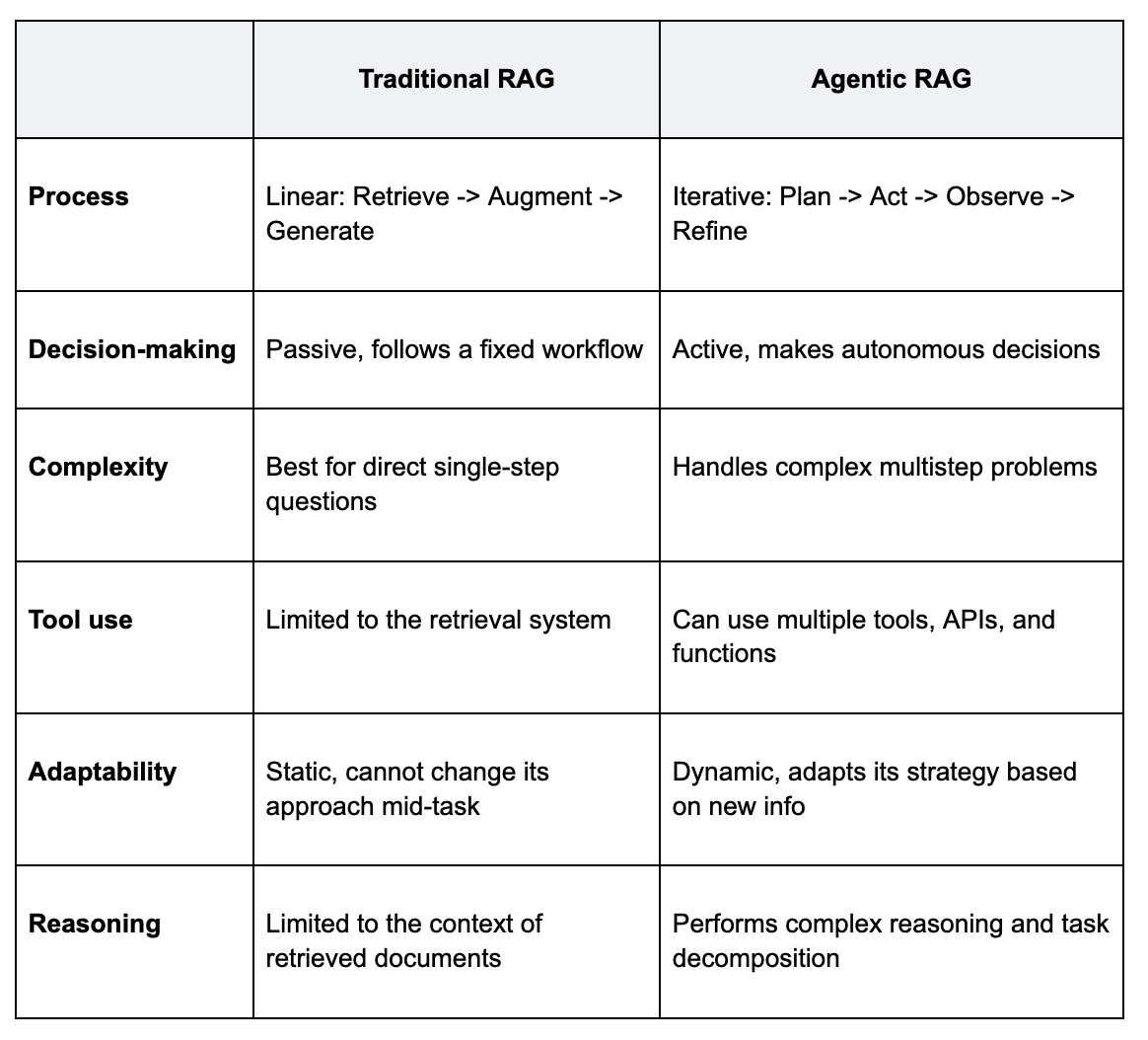
Traditional RAG is sufficient when you need quick, factual answers to well-defined questions, such as “What were our company’s Q3 revenues?” However, it falls short when faced with a query like, “Analyze our Q3 revenue against Q2, identify the top-performing product line, and explain why it succeeded based on recent marketing reports.” This query requires planning, multiple data lookups, and synthesis.
Key components of an agentic RAG system
An agentic RAG system comprises several interconnected parts that work together to achieve a goal.
- Agents and decision logic: The core of the system is the agent, typically an LLM, programmed to make decisions. It uses a reasoning framework (like ReAct: Reason + Act) to break down a user’s goal, form a plan, and execute it step by step.
- Retrieval layer and data sources: These provide the agent’s knowledge base. Data sources can include vector databases for semantic search, traditional databases (SQL), document stores, and knowledge graphs. The agent decides which source is most relevant for each part of its task.
- Memory (short-term and long-term): Memory allows the agent to maintain context. Short-term memory holds information about the current task, including previous steps and retrieved data. Long-term memory can store past interactions and user preferences, enabling personalization and continuous learning.
- Tools, APIs, and external systems: Agents aren’t limited to retrieving text. They can be given access to tools like code interpreters, calculators, search engines, and external APIs (e.g., for weather data or stock prices). This expands the agent’s capabilities beyond its internal knowledge.
- Orchestration and control flow: This component manages the overall process. The orchestrator invokes the agent, provides it with the user’s goal, and manages the execution of its plan. It ensures the agent follows its instructions, handles errors, and produces a final, coherent response.
How agentic RAG works
A workflow of an agentic RAG system is dynamic and iterative. It moves beyond a simple, linear process to a more sophisticated, cyclical one.
- Understanding the user goal: The process begins when the system receives a prompt. The agent’s first job is to interpret the user’s underlying intention, not just the literal words.
- Planning and task decomposition: The agent breaks the complex goal into a series of smaller, manageable subtasks. For example, a request to summarize a sales report might be broken down into: (1) Find the report, (2) Extract key sales figures, (3) Identify trends, and (4) Generate a summary.
- Iterative retrieval and reasoning: The agent executes its plan one step at a time. For each step, it may perform a retrieval action (e.g., query a vector database). It then observes the result. This is a crucial step because if the retrieved information is insufficient or incorrect, the agent can reason through the failure and try a different approach, such as rephrasing its query or consulting a different data source.
- Tool use and validation: If a task requires a calculation or external data, the agent can decide to use one of its available tools. After using a tool or retrieving data, the agent validates the information to ensure it’s relevant and accurate for the task at hand.
- Final response generation: Once the agent determines it’s gathered all the necessary information, it synthesizes everything into a final, comprehensive answer for the user. This response is grounded in the information collected throughout the entire iterative process.
Why use agentic RAG?
Adopting an agentic RAG framework offers major advantages over both standalone LLMs and traditional RAG systems. Some of these benefits include:
- Improved accuracy and grounding: By iteratively refining its search and validating information, the agent is more likely to find the correct data. This reduces the risk of providing answers based on incomplete or irrelevant context.
- Better handling of complex multistep tasks: This is the primary strength of agentic RAG. Its ability to plan and decompose problems allows it to tackle queries that would overwhelm other systems.
- Reduced hallucinations: Because the agent is constantly grounding its reasoning in retrieved data and can self-correct, the likelihood of the LLM making things up is significantly lower.
- Increased adaptability and autonomy: The agent can adapt its strategy in real time. If one approach fails, it can try another. This makes the system more robust and resilient in the face of ambiguity or sparse information.
Common use cases for agentic RAG
Agentic RAG’s ability to handle complexity makes it suitable for a wide range of sophisticated applications. Some of these include:
- Enterprise knowledge assistants: Employees can ask complex questions like, “Which of our projects in the last year went over budget, and what were the common reasons cited in the project post mortems?”
- Complex analytics and reporting: An agent can connect to multiple data sources (databases, CRM data, analytics platforms) to generate in-depth reports that require data aggregation and interpretation.
- Customer support automation: An agentic system can handle complex customer issues that require checking order history, knowledge base articles, and inventory systems before providing a solution.
- DevOps and IT operations: An agent can diagnose system failures by analyzing logs, checking system metrics, and cross-referencing documentation to suggest a fix.
- Research and decision support systems: Researchers can use agents to sift through large numbers of academic papers, extract specific data points, and synthesize findings across multiple studies.
Infrastructure and data considerations
Building a robust agentic RAG system requires careful thought about the underlying infrastructure.
- Vector databases and metadata storage: Vector databases are essential for efficient semantic search. Storing rich metadata alongside the vectors (e.g., creation date, source, author) is equally important, as it allows the agent to perform more targeted, filtered queries.
- Latency, cost, and scalability trade-offs: Agentic systems make multiple calls to LLMs and data sources, which can increase both latency and cost. Designing the system for efficiency (e.g., using smaller, specialized models for certain tasks) is crucial.
- Security, governance, and access control: Since agents can access sensitive data and execute actions, strong governance is nonnegotiable. It’s crucial to implement robust access controls so the agent can only access the data and tools it’s authorized to use.
Challenges and trade-offs
Along with its many benefits, agentic RAG also brings challenges. You should be ready to address:
- Increased system complexity: An agentic architecture has many moving parts. Designing, building, and maintaining it is significantly more complex than a traditional RAG pipeline.
- Debugging and observability: When an agent produces a wrong answer, tracing the error back through a complex chain of thought and action can be difficult. Good logging and observability tools are essential.
- Evaluation and testing difficulties: Because traditional metrics are often insufficient, new testing methods are required to assess the agent’s reasoning and decision-making quality.
- Performance and cost considerations: The iterative nature of agents means more LLM calls, which can lead to higher costs and slower response times. Optimizing the agent’s strategy to be as efficient as possible is a key challenge.
Agentic RAG vs. alternatives
When building an AI application, it’s important to choose the right tool for the job. You should consider the differences between:
- Agentic RAG vs. traditional RAG: Use traditional RAG for simple Q&A. Use agentic RAG when the task requires planning, multistep reasoning, or multiple tools.
- Agentic RAG vs. fine-tuning: Fine-tuning adapts an LLM to a specific style or knowledge domain and is useful for teaching an LLM a new skill. Agentic RAG is about providing an LLM with the ability to reason and use tools. The two approaches are complementary when you use a fine-tuned model as the brain of your agent.
- Agentic RAG vs. engenharia de prompt: Advanced prompt engineering can lead to impressive behavior from an LLM, but it’s brittle. An agentic framework provides a more structured and reliable way to guide the model’s reasoning process, especially for complex tasks.
Choose agentic RAG when you need a system that can dynamically plan and adapt to solve a problem, rather than just answer a question based on static knowledge.
Best practices for building agentic RAG
If you build an agentic RAG system, these best practices will maximize your success.
- Start with clear goals and constraints: Define precisely what you want the agent to accomplish. Set clear boundaries on what tools it can use and what data it can access.
- Keep agents narrowly scoped: Instead of building one monolithic agent that does everything, consider creating multiple smaller agents, each specializing in a specific task. An orchestrator can then route tasks to the appropriate agent.
- Use structured memory and retrieval: Don’t rely solely on unstructured text. Using structured data sources like knowledge graphs and well-defined metadata allows the agent to make more precise and efficient queries.
- Monitor, evaluate, and iterate: Agentic systems require continuous monitoring. Log the agent’s reasoning process, evaluate its performance against predefined benchmarks, and use those insights to refine its logic and tools.
Here’s a more advanced look at planning an agentic app.
Principais conclusões e recursos relacionados
Agentic RAG marks a significant step forward in our ability to build truly intelligent AI systems. By giving RAG the power to plan, act, and reason, we can create applications that go beyond simple question answering to become active partners in problem solving. This approach allows AI to tackle complex real-world challenges with greater accuracy and autonomy.
Principais conclusões
- Agentic RAG combines autonomous agents with retrieval-augmented generation.
- It excels at complex multistep problems where traditional RAG falls short.
- Key components include agents, memory, tools, and an orchestration layer.
- The process is iterative: plan, act, observe, and refine.
- It improves accuracy and reduces hallucinations by grounding reasoning in validated data.
- Building agentic RAG systems involves significant complexity and cost trade-offs.
- Best practices include starting with clear goals, using specialized agents, and continuous monitoring.
To learn more about agentic AI and RAG, you can visit the resources below:
Recursos relacionados
- What Is an AI Agent? An Explainer – Blog
- AI Services in Capella – Products
- Capella AI Services: Build Enterprise-Grade Agents – Blog
- Develop AI Apps With Couchbase Using LlamaIndex – Developers
Perguntas Frequentes
How does agentic RAG scale in production environments? Scaling agentic RAG requires optimizing for latency and cost. This can involve using smaller, faster LLMs for intermediate reasoning steps, caching results of common queries, and running retrieval and tool-use operations in parallel. Infrastructure must be designed for high throughput and low-latency data access.
How can agentic RAG be evaluated and tested? Evaluation is complex. It involves not only checking the final answer’s correctness but also assessing the quality of the agent’s reasoning path. This can be done by creating test suites with complex questions and using tracer tools to log the agent’s step-by-step logic, tool usage, and intermediate results for manual or automated review.
How does agentic RAG support personalização and context awareness? The memory component provides this support. Short-term memory tracks the current conversation, allowing the agent to understand context. Long-term memory can store information about past interactions, user preferences, and roles, enabling the agent to tailor its responses and actions specifically to the user.
What skills do teams need to build and maintain agentic RAG systems? Teams need a mix of skills, including data engineering (for the retrieval pipeline), software engineering (for building the agentic framework and tool integrations), and LLM expertise (for prompt engineering and model selection). Strong skills in observability and system design are also crucial for debugging and maintenance.
Is agentic RAG suitable for regulated or high-stakes domains? It can be, but it requires extremely strong governance and safety measures. This includes strict access controls, human-in-the-loop validation for critical actions, comprehensive audit trails of the agent’s decisions, and robust testing to ensure reliability and prevent unintended consequences.
What does the future look like for agentic RAG architectures? The future will likely involve more sophisticated multi-agent systems, where specialized agents collaborate to solve even more complex problems. We can also expect agents that can automatically learn and create their own tools, becoming more autonomous and capable over time. The integration of more advanced reasoning frameworks and more efficient models will continue to push the boundaries of what’s possible.

Deixe um comentário
Você precisa fazer o login para publicar um comentário.