
Category: Couchbase Server

ASP.NET Core Microservices: Getting Started
ASP.NET Core Microservices will be responsible for a single "vertical" slice of an overall application/service architecture.

How to Update Python 2 to Python 3 & The Differences Between Them
Learn how to update from Python 2 to 3 in this post from Couchbase. We also cover their key differences and identify common problems with migration.

Testing N1QL Workloads with Apache JMeter
One of the key features that Couchbase provides for querying JSON data is a N1QL language. N1QL allows users to access and modify the contents of their JSON documents with familiar SQL statements. Quite often, during development phase of a...

Few Index Management Tips – FTS Best Practices Part II
Couchbase FTS Index management and debugging tips for text analysis debugging or on any under sizing signposts to help you manage the indexes effectively.

Deep Dive: Window functions in Couchbase Analytics
Couchbase Server 6.5 brings a host of new features [1] to the leading NoSQL database. One of the key additions to the N1QL query language is support for window functions. These functions were originally introduced in the SQL:2003 standard and provide...

Infosys “OpenHack” Development Program Features Couchbase
Senior architects from Couchbase and Infosys played the role of “master hacks” mentoring and reviewing various solutions from the 5 week "OpenHacks" event.

Tutorial: Couchbase Autonomous Operator On Minikube
Follow this hands-on tutorial hands-on tutorial for setting up Couchbase Kubernetes Operator on a laptop/desktop running minikube.

Analytics Explain Plan – Part 1
Co-author: Till Westmann, Senior Director, Engineering Introduction Couchbase Analytics is the “newest kid on the block” amongst all the services available in Couchbase Server. The new service is providing rapid time to insight in many use cases like ship to...

Window functions in Couchbase Analytics
Co-author: Till Westmann, Senior Director, Engineering The bits for Couchbase 6.5, the upcoming release of Couchbase Server, are now available. The Analytics service, which supports efficient parallel query processing, has added support for support for window functions defined in the...
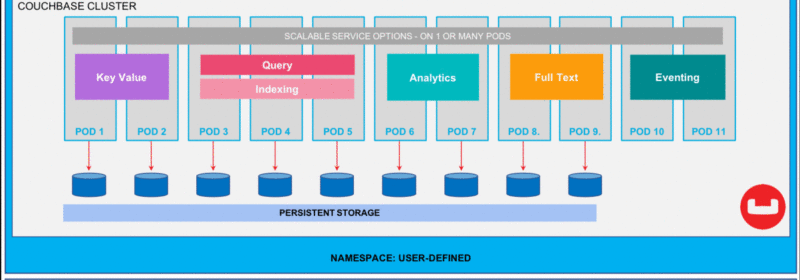
Self-healing Clusters using Kubernetes Persistent Volumes
Self-healing Couchbase Clusters are made possible by Kubernetes container orchestration that abstracts away the complexities of underlying infrastructure.

Couchbase Supports Multi-Document ACID Transactions
Let’s look at how we address ACID guarantees in Couchbase – a distributed database that’s built on a shared-nothing architecture.

Exercising Control on Quality of Service Using XDCR
XDCR, by design, provides customers the flexibility to tune the number of replications for a given bucket depending on the desired performance. New replication requires streaming all existing documents in the bucket, and, therefore, it exhibits a higher mutation rate...
Top Posts
- Data Modeling Explained: Conceptual, Physical, Logical
- Data Analysis Methods: Qualitative vs. Quantitative Techniques
- What are Embedding Models? An Overview
- Application Development Life Cycle (Phases and Management Models)
- What are Vector Embeddings?
- What Is Data Analysis? Types, Methods, and Tools for Research
- The Importance of Data Preprocessing in Machine Learning (ML)
- Semantic Search vs. Keyword Search: What’s the Difference?
- A Breakdown of Graph RAG vs. Vector RAG


