

In this CodeLab, you will learn how to build a Hotel Search Agent using 랑체인, Couchbase AI Services, 그리고 에이전트 카탈로그. We will also incorporate Arize Phoenix for observability and evaluation to ensure our agent performs reliably.
This tutorial takes you from zero to a fully functional agent that can search for hotels, filter by amenities, and answer natural language queries using real-world data.
Note: You can find the full Google CodeLab notebook for this CodeLab 여기.
What Are Couchbase AI Services?
Building AI applications often involves juggling multiple services: a vector database for memory, an inference provider for LLMs (like OpenAI or Anthropic), and separate infrastructure for embedding models.
Couchbase AI Services streamlines this by providing a unified platform where your operational data, vector search, and AI models live together. It offers:
- LLM inference and embeddings API: Access popular LLMs (like Llama 3) and embedding models directly within Couchbase Capella, with no external API keys, no extra infrastructure, and no data egress. Your application data stays inside Capella. Queries, vectors, and model inference all happen where the data lives. This enables secure, low-latency AI experiences while meeting privacy, compliance requirements. Thus, the key value: data and AI together, without sending sensitive information outside your system.
- Unified platform: Database + Vectorization + Search + Model
- Integrated vector search: Perform semantic search directly on your JSON data with millisecond latency.
Why Is This Needed?
As we move from simple chatbots to agentic workflows, where AI models autonomously use tools, latency, and complexity of setup become bottlenecks. By co-locating your data and AI services, you reduce the operational overhead and latency. Furthermore, tools like the 에이전트 카탈로그 help with managing hundreds of agent prompts and tools and provide built in logging for your agents.
전제 조건
Before we begin, ensure you have:
- A 카우치베이스 카펠라 account.
- Python 3.10+ installed.
- Basic familiarity with Python and Jupyter notebooks.
Create a Cluster in Couchbase Capella
- Log into Couchbase Capella.
- Create a new cluster or use an existing one. Note that the cluster needs to run the latest version of Couchbase Server 8.0 with the Data, Query, Index, and the Eventing services.
- Create a bucket.
- Create a scope and collection for your data.
Step 1: Install Dependencies
We’ll start by installing the necessary packages. This includes the couchbase-infrastructure helper for setup, the agentc CLI for the catalog, and the LangChain integration packages.
|
1 2 3 4 5 6 7 8 9 10 11 12 13 14 |
%pip 설치 –q “pydantic>=2.0.0,<3.0.0” “python-dotenv>=1.0.0,<2.0.0” “pandas>=2.0.0,<3.0.0” “nest-asyncio>=1.6.0,<2.0.0” “langchain-couchbase>=0.2.4,<0.5.0” “langchain-openai>=0.3.11,<0.4.0” “arize-phoenix>=11.37.0,<12.0.0” “openinference-instrumentation-langchain>=0.1.29,<0.2.0” “couchbase-infrastructure” # Install Agent Catalog %pip 설치 agentc==1.0.0 |
Step 2: Infrastructure as Code
Instead of manually clicking through the UI, we use the couchbase-infrastructure package to programmatically provision our Capella environment. This ensures a reproducible setup.
We will:
- Create a Project and Cluster.
- Deploy an Embedding Model (
nvidia/llama-3.2-nv-embedqa-1b-v2) and an LLM (meta/llama3-8b-instruct). - Load the
여행 샘플dataset.
Couchbase AI Services provides OpenAI-compatible endpoints that are used by the agents.
|
1 2 3 4 5 6 7 8 9 10 11 12 13 14 15 16 17 18 19 20 21 22 23 24 25 26 27 28 29 30 31 32 33 34 35 36 37 38 39 40 41 42 43 44 45 46 47 |
가져오기 os 에서 getpass 가져오기 getpass 에서 couchbase_infrastructure 가져오기 CapellaConfig, CapellaClient 에서 couchbase_infrastructure.resources 가져오기 ( create_project, create_developer_pro_cluster, add_allowed_cidr, load_sample_data, create_database_user, deploy_ai_model, create_ai_api_key, ) # 1. Collect Credentials management_api_key = getpass(“Enter your MANAGEMENT_API_KEY: “) organization_id = input(“Enter your ORGANIZATION_ID: “) 설정 = CapellaConfig( management_api_key=management_api_key, organization_id=organization_id, project_name=“agent-app”, cluster_name=“agent-app-cluster”, db_username=“agent_app_user”, sample_bucket=“트래블 샘플”, # Using Couchbase AI Services for models embedding_model_name=“nvidia/llama-3.2-nv-embedqa-1b-v2”, llm_model_name=“meta/llama3-8b-instruct”, ) # 2. Provision Cluster 클라이언트 = CapellaClient(설정) org_id = 클라이언트.get_organization_id() project_id = create_project(클라이언트, org_id, 설정.project_name) cluster_id = create_developer_pro_cluster(클라이언트, org_id, project_id, 설정.cluster_name, 설정) # 3. Network & Data Setup add_allowed_cidr(클라이언트, org_id, project_id, cluster_id, “0.0.0.0/0”) # Allow all IPs for tutorial load_sample_data(클라이언트, org_id, project_id, cluster_id, 설정.sample_bucket) db_password = create_database_user(클라이언트, org_id, project_id, cluster_id, 설정.db_username, 설정.sample_bucket) # 4. Deploy AI Models print(“Deploying AI Models…”) deploy_ai_model(클라이언트, org_id, 설정.embedding_model_name, “agent-hub-embedding-model”, “embedding”, 설정) deploy_ai_model(클라이언트, org_id, 설정.llm_model_name, “agent-hub-llm-model”, “llm”, 설정) # 5. Generate API Keys API 키 = create_ai_api_key(클라이언트, org_id, 설정.ai_model_region) |
Ensure to follow the steps to setup the security root certificate. Secure connections to Couchbase Capella require a root certificate for TLS verification. You can find this in the ## 📜 Root Certificate Setup section of the Google Colab Notebook.
Step 3: Integrating Agent Catalog
그 에이전트 카탈로그 is a powerful tool for managing the lifecycle of your agent’s capabilities. Instead of hardcoding prompts and tool definitions in your Python files, you manage them as versioned assets. You can centralize and reuse your tools across your development teams. You can also examine and monitor agent responses with the Agent Tracer.
Initialize and Download Assets
First, we initialize the catalog and download our pre-defined prompts and tools.
|
1 2 3 4 5 6 7 8 |
!깃 초기화 !agentc 초기화 # Download example tools and prompts !mkdir –p prompts 도구 !Wget –O prompts/hotel_search_assistant.yaml https://raw.githubusercontent.com/couchbase-examples/agent-catalog-quickstart/refs/heads/main/notebooks/hotel_search_agent_langchain/prompts/hotel_search_assistant.yaml !Wget –O 도구/search_vector_database.py https://raw.githubusercontent.com/couchbase-examples/agent-catalog-quickstart/refs/heads/main/notebooks/hotel_search_agent_langchain/tools/search_vector_database.py !Wget –O agentcatalog_index.JSON https://raw.githubusercontent.com/couchbase-examples/agent-catalog-quickstart/refs/heads/main/notebooks/hotel_search_agent_langchain/agentcatalog_index.json |
Index and Publish
We use agentc to index our local files and publish them to Couchbase. This stores the metadata in your database, making it searchable and discoverable by the agent at runtime.
|
1 2 3 4 5 |
# Create local index of tools and prompts !agentc 색인 . # Upload to Couchbase !agentc 게시 |
Step 4: Preparing the Vector Store
To enable our agent to search for hotels semantically (e.g., “cozy place near the beach”), we need to generate vector embeddings for our hotel data.
We define a helper to format our hotel data into a rich text representation, prioritizing location and amenities.
|
1 2 3 4 5 6 7 8 9 10 11 12 13 14 15 16 17 18 19 20 21 22 23 |
에서 langchain_couchbase.vectorstores 가져오기 CouchbaseVectorStore def load_hotel_data_to_couchbase(클러스터, bucket_name, scope_name, collection_name, 임베딩, index_name): # Check if data exists # … (omitted for brevity) … # Generate rich text for each hotel # e.g., “Le Clos Fleuri in Giverny, France. Amenities: Free breakfast: Yes…” hotel_texts = get_hotel_texts() # Initialize Vector Store connected to Capella vector_store = CouchbaseVectorStore( 클러스터=클러스터, bucket_name=bucket_name, scope_name=scope_name, collection_name=collection_name, 임베딩=임베딩, index_name=index_name, ) # Batch upload texts vector_store.add_texts(texts=hotel_texts) print(f“Successfully loaded {len(hotel_texts)} hotel embeddings”) |
Step 5: Building the LangChain Agent
We use the 에이전트 카탈로그 to fetch our tool definitions and prompts dynamically. The code remains generic, while your capabilities (tools) and personality (prompts) are managed separately. We will also create our ReAct agents.
|
1 2 3 4 5 6 7 8 9 10 11 12 13 14 15 16 17 18 19 20 21 22 23 24 25 26 27 28 29 30 31 32 33 34 35 36 37 38 39 40 41 42 43 44 45 46 47 |
가져오기 agentc 에서 랑체인.agents 가져오기 AgentExecutor, create_react_agent 에서 langchain_core.prompts 가져오기 PromptTemplate 에서 langchain_core.도구 가져오기 Tool def create_langchain_agent(self, catalog, span): # 1. Setup AI Services using Capella endpoints 임베딩, 대규모 언어 모델 = setup_ai_services(framework=“langchain”) # 2. Discover Tools from Catalog # The catalog.find() method searches your published catalog tool_search = catalog.찾다(“tool”, 이름=“search_vector_database”) 도구 = [ Tool( 이름=tool_search.meta.이름, 설명=tool_search.meta.설명, func=tool_search.func, # The actual python function ), ] # 3. Discover Prompt from Catalog hotel_prompt = catalog.찾다(“prompt”, 이름=“hotel_search_assistant”) # 4. Construct the Prompt Template custom_prompt = PromptTemplate( template=hotel_prompt.콘텐츠.strip(), input_variables=[“input”, “agent_scratchpad”], partial_variables={ “tools”: “n”.가입하기([f“{tool.name}: {tool.description}” ~를 위해 tool 안으로 도구]), “tool_names”: “, “.가입하기([tool.이름 ~를 위해 tool 안으로 도구]), }, ) # 5. Create the ReAct Agent 에이전트 = create_react_agent(대규모 언어 모델, 도구, custom_prompt) agent_executor = AgentExecutor( 에이전트=에이전트, 도구=도구, verbose=True, handle_parsing_errors=True, # Auto-correct formatting errors max_iterations=5, return_intermediate_steps=True, ) 반환 agent_executor |
Step 6: Running the Agent
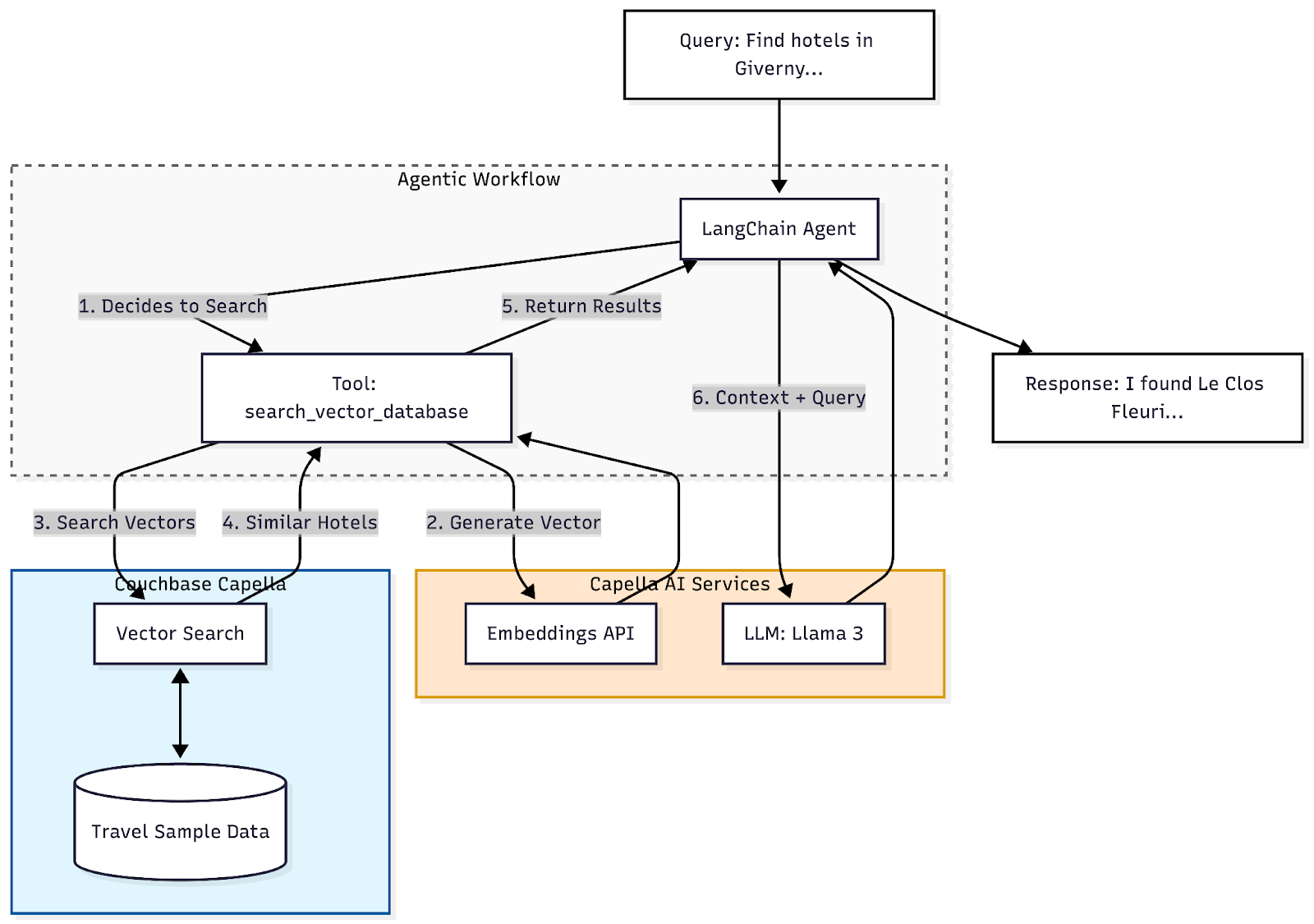
With the agent initialized, we can perform complex queries. The agent will:
- Receive the user input.
- Decide it needs to use the
search_vector_databasetool. - Execute the search against Capella.
- Synthesize the results into a natural language response.
|
1 2 3 4 5 6 7 8 9 10 11 12 13 |
# Initialize Agent Catalog catalog = agentc.catalog.Catalog() span = catalog.Span(이름=“Hotel Support Agent”, blacklist=설정()) # Create the agent agent_executor = couchbase_client.create_langchain_agent(catalog, span) # Run a query 질의 = “Find hotels in Giverny with free breakfast” 응답 = agent_executor.invoke({“input”: 질의}) print(f“User: {query}”) print(f“Agent: {response[‘output’]}”) |
Example Output:
Agent: I found a hotel in Giverny that offers free breakfast called Le Clos Fleuri. It is located at 5 rue de la Dîme, 27620 Giverny. It offers free internet and parking as well.
참고: In Capella Model Services, the model outputs can be cached (both semantic and standard cache). The caching mechanism enhances the RAG’s efficiency and speed, particularly when dealing with repeated or similar queries. When a query is first processed, the LLM generates a response and then stores this response in Couchbase. When similar queries come in later, the cached responses are returned. The caching duration can be configured in the Capella Model services.
Adding Semantic Caching
Caching is particularly valuable in scenarios where users may submit similar queries multiple times or where certain pieces of information are frequently requested. By storing these in a cache, we can significantly reduce the time it takes to respond to these queries, improving the user experience.
|
1 2 3 4 5 6 7 8 9 10 11 12 13 14 15 16 17 18 19 20 21 22 23 24 25 26 27 28 29 30 31 32 33 34 35 36 37 38 39 40 41 |
## Semantic Caching Demonstration # This section demonstrates how to enable and use Semantic Caching with Capella Model Services. # Semantic caching stores responses for queries and reuses them for semantically similar future queries, significantly reducing latency and cost. # 1. Setup LLM with Semantic Caching enabled # We pass the “X-cb-cache”: “semantic” header to enable the feature print(” Setting up LLM with Semantic Caching enabled…”) llm_with_cache = ChatOpenAI( 모델=os.environ[“CAPELLA_API_LLM_MODEL”], base_url=os.environ[“CAPELLA_API_LLM_ENDPOINT”] + “/v1” 만약 not os.environ[“CAPELLA_API_LLM_ENDPOINT”].endswith(“/v1”) 그 외 os.environ[“CAPELLA_API_LLM_ENDPOINT”], API 키=os.environ[“CAPELLA_API_LLM_KEY”], temperature=0, # Deterministic for caching default_headers={“X-cb-cache”: “semantic”} ) # 2. Define a query and a semantically similar variation query_1 = “What are the best hotels in Paris with a view of the Eiffel Tower?” query_2 = “Recommend some hotels in Paris where I can see the Eiffel Tower.” print(f“n Query 1: {query_1}”) print(f” Query 2 (Semantically similar): {query_2}”) # 3. First execution (Cache Miss) print(“n Executing Query 1 (First run – Cache MISS)…”) start_time = time.time() response_1 = llm_with_cache.invoke(query_1) end_time = time.time() time_1 = end_time – start_time print(f” Time taken: {time_1:.4f} seconds”) print(f” Response: {response_1.content[:100]}…”) # 4. Second execution (Cache Hit) # The system should recognize query_2 is semantically similar to query_1 and return the cached response print(“n Executing Query 2 (Semantically similar – Cache HIT)…”) start_time = time.time() response_2 = llm_with_cache.invoke(query_2) end_time = time.time() time_2 = end_time – start_time print(f” Time taken: {time_2:.4f} seconds”) print(f” Response: {response_2.content[:100]}…”) |
Step 7: Observability With Arize Phoenix
In production, you need to know why an agent gave a specific answer. We use Arize Phoenix to trace the agent’s “thought process” (the ReAct chain).
We can also run evaluations to check for hallucinations 또는 relevance.
|
1 2 3 4 5 6 7 8 9 10 11 12 13 14 15 16 17 18 19 20 21 |
가져오기 phoenix as px 에서 phoenix.evals 가져오기 llm_classify, LENIENT_QA_PROMPT_TEMPLATE # 1. Start Phoenix Server 세션 = px.launch_app() # 2. Instrument LangChain 에서 openinference.instrumentation.랑체인 가져오기 LangChainInstrumentor LangChainInstrumentor().instrument() # … Run your agent queries … # 3. Evaluate Results # We use an LLM-as-a-judge to grade our agent’s responses hotel_qa_results = llm_classify( 데이터=hotel_eval_df[[“input”, “output”, “reference”]], 모델=evaluator_llm, template=LENIENT_QA_PROMPT_TEMPLATE, rails=[“correct”, “incorrect”], provide_explanation=True, ) |
By inspecting the Phoenix UI, you can visualize the exact sequence of tool calls and see the latency of each step in the chain.
결론
We have successfully built a robust Hotel Search Agent. This architecture leverages:
- Couchbase AI Services: For a unified, low-latency data and AI layer.
- 에이전트 카탈로그: For organized, versioned management of agent tools and prompts. Agent catalog also provides tracing. It provides users to use SQL++ with traces, leverage the performance of Couchbase, and get insight into details of prompts and tools in the same platform.
- LangChain: For flexible orchestration.
- Arize Phoenix: For observability.
This approach scales well for teams building complex, multi-agent systems where data management and tool discovery are critical challenges.

댓글 남기기
댓글을 달기 위해서는 로그인해야합니다.