임베딩 모델이란 무엇인가요?
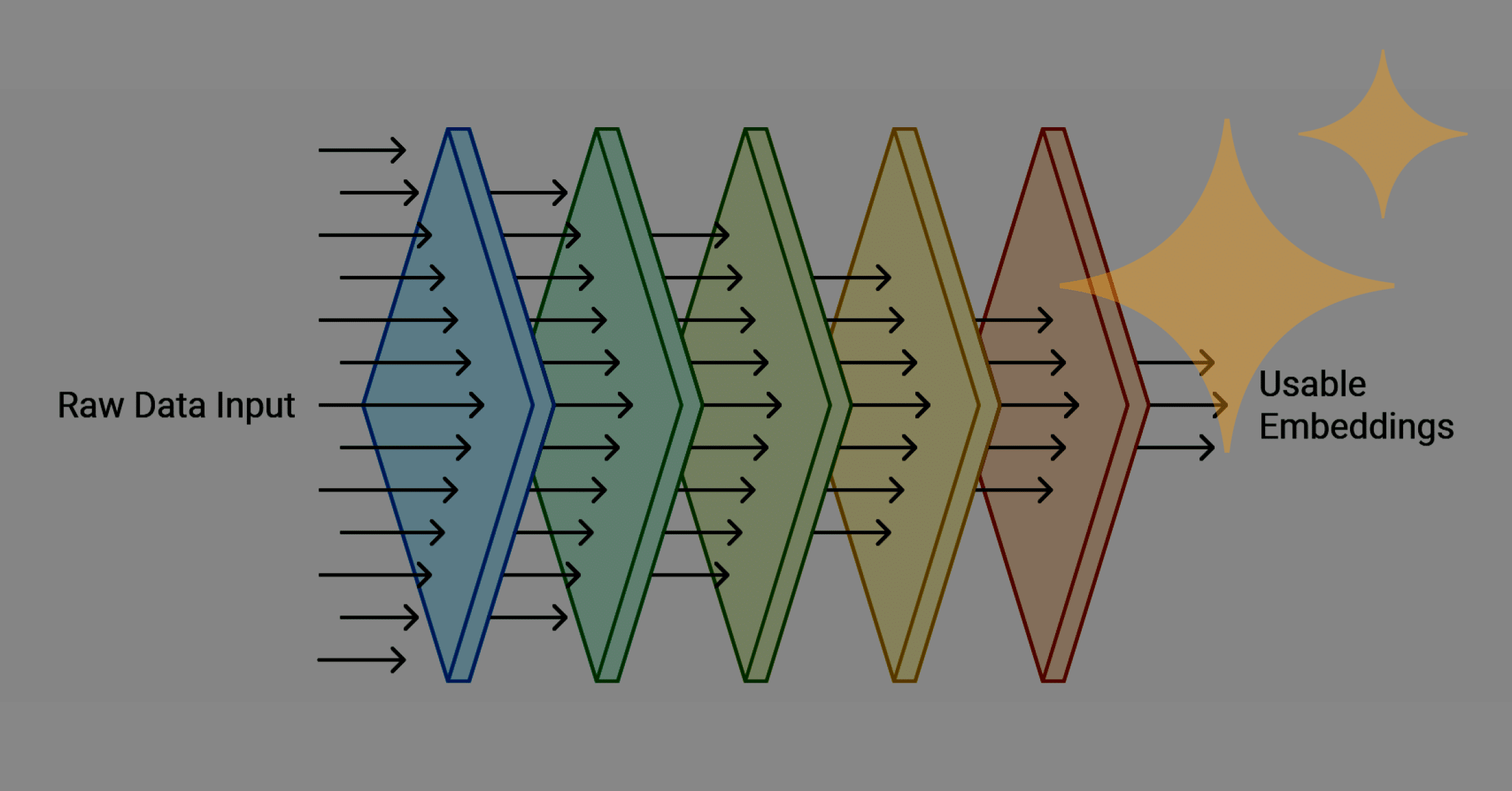
임베딩 모델은 텍스트, 이미지 또는 기타 형태의 정보와 같은 데이터를 연속적이고 저차원적인 벡터 공간으로 표현하도록 설계된 일종의 머신러닝 모델입니다. 이러한 임베딩 데이터 조각 간의 의미적 또는 문맥적 유사성을 포착하여, 기계가 비교, 군집화, 분류 등의 작업을 더욱 효과적으로 수행할 수 있도록 합니다.
당신이 다양한 과일을 묘사하고 싶다고 상상해 보세요. 긴 설명 대신 당도, 크기, 색상 같은 특성에 숫자를 사용하는 것입니다. 예를 들어 사과는 [8, 5, 7]일 수 있고 바나나는 [9, 7, 4]입니다. 이 숫자를 통해 비슷한 과일을 더 쉽게 비교하거나 그룹화할 수 있습니다.
임베딩 모델은 무엇을 하나요?
임베딩 모델은 텍스트, 이미지, 오디오를 의미 있는 숫자로 변환하고 이를 비교하여 패턴이나 연관성을 찾아냅니다. 이 과정은 도서관이 책을 장르나 주제별로 분류하여 사용자가 원하는 것을 더 빨리 찾을 수 있도록 돕는 것과 유사합니다.
다음은 임베딩 모델의 일상적인 사용 사례 예시입니다:
텍스트 검색
검색 엔진에 “best Greek food”를 입력한다고 상상해 보세요. 임베딩 모델이 여러분의 검색어를 숫자로 변환하고 유사한 임베딩을 가진 문서를 검색할 것입니다. 그런 다음 모델이 검색어와 가까운 결과를 보여줄 것입니다.
영화 추천해 드립니다.
영화를 마음에 들어 했다면, 시스템은 임베딩 모델을 사용하여 해당 영화를 숫자(예: 장르, 출연진, 분위기)로 표현합니다. 이 숫들을 다른 영화 임베딩과 비교하여 유사한 영화를 추천합니다.
이미지와 캡션 연결하기
임베딩 모델은 이미지와 잠재적인 캡션을 모두 수치 표현(임베딩)으로 변환하여 바다 위 일몰 이미지와 “잔잔한 파도 위로 펼쳐지는 평온한 일몰”이라는 캡션을 서로 일치시킬 수 있습니다. 이 모델은 이미지의 임베딩에 가장 가까운 임베딩을 가진 캡션을 식별하여 정확한 일치를 보장합니다. 이 기술은 이미지 검색 및 사진 태깅과 같은 도구의 기반이 됩니다.
비슷한 항목 그룹화
쇼핑 웹사이트는 임베딩을 사용하여 유사한 제품을 그룹화합니다. 예를 들어, 임베딩 공간에서 “빨간색 스니커즈”는 “파란색 스니커즈”와 가까울 수 있으므로 관련 상품으로 표시됩니다.
임베딩 모델의 종류
다양한 임베딩 모델이 있으며, 각각은 서로 다른 유형의 데이터와 작업에 맞춰 설계되었습니다. 주요 유형은 다음과 같습니다.
단어 임베딩 모델
이 모델들은 단어들을 의미적 의미와 단어 간의 관계를 포착하는 수치 벡터로 변환합니다. 예시는 다음과 같습니다:
- 워드투벡터: 문맥을 기반으로 단어를 예측하거나(스킵그램) 단어를 기반으로 문맥을 예측하여(CBOW) 단어 임베디드를 학습합니다.
- GloVe(단어 표현을 위한 전역 벡터): 대규모 말뭉치의 단어 동시 출현 통계를 사용하여 임베딩을 생성하는 모델.
- 패스트텍스트: Word2vec과 유사하지만 서브워드 정보를 고려하여 형태소가 풍부한 언어에 더 효과적입니다.
문맥화된 워드 임베딩 모델
이 모델들은 단어가 나타나는 문맥을 기반으로 동적 단어 임베딩을 생성합니다. 정적 임베딩과 달리, 단어의 의미는 사용 방식에 따라 달라질 수 있습니다.
- BERT(양방향 인코더 트랜스포머 표현): 주변 단어의 문맥을 기반으로 단어 임베딩을 생성하여 질의응답 및 감성 분석과 같은 작업에 매우 효과적입니다.
- GPT (생성형 사전 훈련 트랜스포머): 텍스트 생성 및 기타 언어 작업을 위한 문맥화된 임베딩을 생성합니다.
- ELMo (언어 모델 임베딩): 전체 문장 맥락을 기반으로 단어 임베딩을 제공하여 더 깊은 의미를 포착할 수 있게 합니다.
문장 또는 문서 임베딩 모델
이 모델들은 개별 단어가 아닌 문장이나 문서 전체를 나타내는 임베디드를 생성합니다.
- Doc2vec: 문서 내 단어들의 문맥을 고려하여 전체 문서에 대한 임베딩을 생성하는 Word2vec의 확장 버전.
- 인퍼센트 문장 유사도 및 분류와 같은 태스크를 위해 문장을 임베딩으로 매핑하도록 학습하는 문장 인코더.
이미지 임베딩 모델
이 모델들은 이미지를 벡터로 표현하여 이미지 인식 및 검색과 같은 작업을 가능하게 합니다.
- 합성곱 신경망 (CNN): ResNet 및 VGG와 같은 모델은 이미지에서 특징을 추출하고 이미지 분류 및 인식 임베딩을 생성합니다.
- CLIP (대조 학습 기반 언어-이미지 사전 학습): 이미지와 텍스트 설명 모두에 대한 임베딩을 생성하고 이미지-텍스트 검색과 같은 작업을 위해 동일한 벡터 공간에서 이들을 정렬하여 이미지와 텍스트 설명을 연결하는 모델.
오디오 및 음성 임베딩 모델
이 모델들은 오디오 또는 음성 데이터를 음성 인식 및 감정 감지와 같은 작업에 유용한 임베딩으로 변환합니다.
- VGGish: CNN을 기반으로 하는 오디오, 특히 음악 및 음성용 임베딩 모델입니다.
- Wav2vec: A model by Meta AI that generates embeddings for raw speech audio, which is effective for speech-to-text tasks.
Each model is designed to handle specific types of data and tasks, helping to capture and represent relationships usefully for machine learning applications.
How are embedding models trained?
Embedding models are trained using large datasets and specific learning objectives that guide them to create meaningful numerical data representations. The training process involves the following steps:
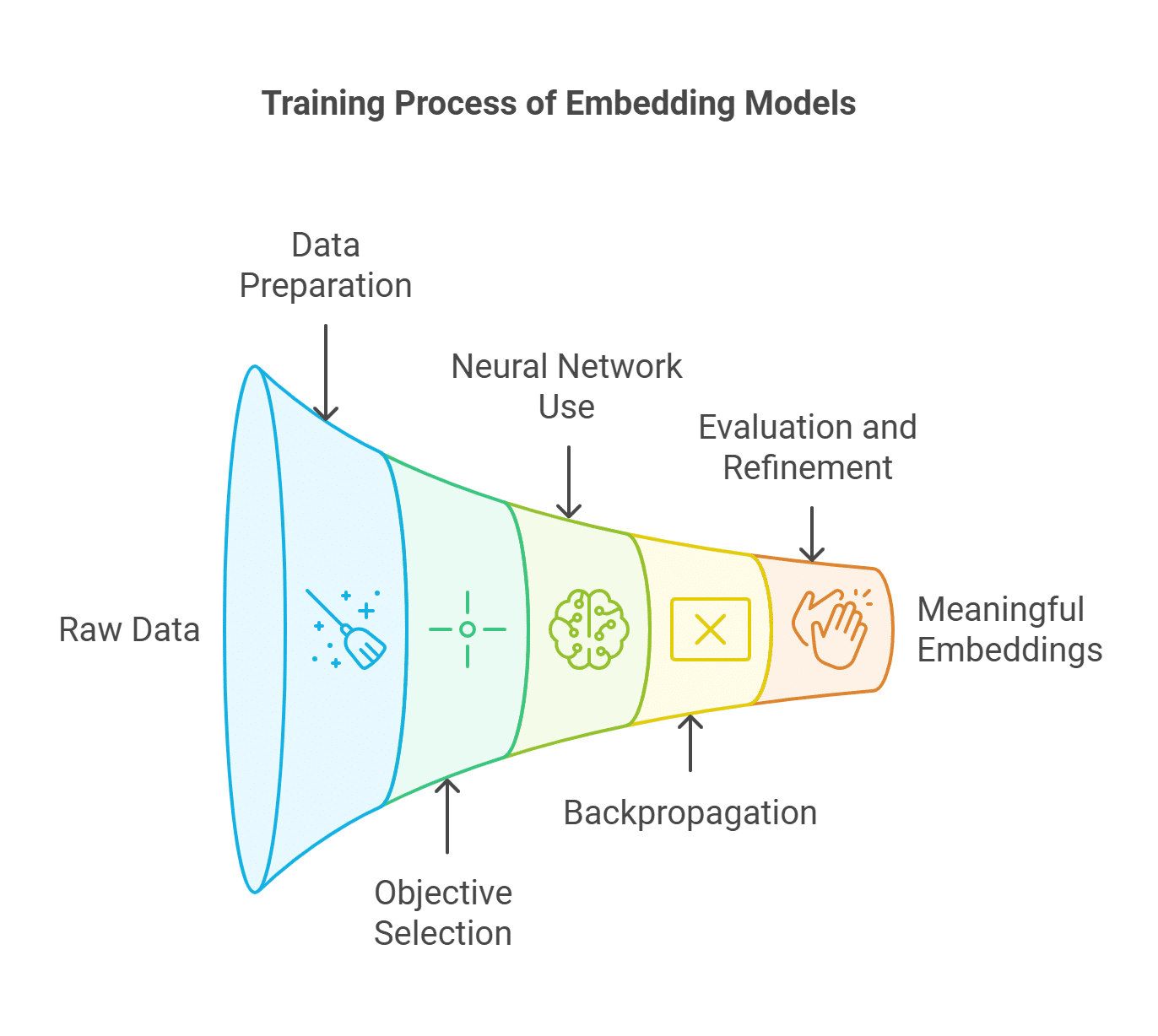
1. Collecting and preparing data
- Datasets: Large datasets (like text corpora) are required for language embeddings, labeled image datasets for visual embeddings, and paired datasets (e.g., images and captions) for multimodal embeddings.
- Preprocessing: Text is tokenized into words or subwords, images are resized and normalized, and audio is transformed into spectrograms or other formats.
2. Choosing a training objective
The model learns to create embeddings by optimizing for a specific objective. Common objectives include:
- Predicting context (language models)
- 예시: Word2vec’s skip-gram model predicts surrounding words for a given word. If the input is “The cat sat on the __,” the model might predict “mat.”
- Minimizing differences in related data (contrastive learning)
- 예시: In CLIP, an image and its caption are brought closer in the embedding space, while unrelated images and captions are pushed further apart.
- Classification or task-specific objectives
- 예시: A model might predict whether an image contains a dog or cat. The embeddings are adjusted to make the task easier by clustering similar images.
3. Using neural networks
- Shallow models: Early models like Word2vec use simple neural networks to learn embeddings based on co-occurrence patterns.
- Deep models: Transformers (e.g., BERT, GPT) and CNNs extract more complex patterns and relationships by processing data in layers.
4. Backpropagation and optimization
- The model makes a prediction, calculates an error (the difference between the prediction and the target), and adjusts its parameters using backpropagation.
- An optimizer (like Adam or SGD) updates the embeddings and the model’s weights to minimize this error.
5. Evaluating and refining
- The model is evaluated using validation data to ensure it produces meaningful embeddings for the intended tasks.
- Adjustments like hyperparameter tuning or fine-tuning on specific datasets are made to improve performance.
How do embedding models work?
Now, let’s dive into how these models work:

1. Input data processing
The model inputs raw data (e.g., text, images, or audio) and pre-processes it in the following manner:
- Text is tokenized into smaller units like words or subwords.
- Images are broken into smaller elements like pixels or features.
- Audio is converted into waveforms or spectrograms.
2. Feature extraction
The embedding model analyzes the input to identify key features:
- With text, it considers the context and meaning of words.
- With images, it detects visual patterns, colors, or shapes.
- With audio, it identifies tones, frequencies, or rhythms.
For example, Word2vec learns relationships between words based on how often they appear together in a large dataset. For example, it might notice that “king” and “queen” frequently appear in similar contexts and assign them close embeddings in the vector space.
3. Dimensionality reduction
High-dimensional data (e.g., an image with millions of pixels) is compressed into a lower-dimensional vector. This vector preserves the essential information while discarding unnecessary details. For instance, an image might be reduced to a 512-dimensional vector, capturing its main features without retaining the full resolution.
4. Learning through training
Embedding models are trained on large datasets using machine learning techniques to detect patterns and relationships. These techniques include:
- Unsupervised learning: The model learns to organize data by clustering similar words or images together.
- Supervised learning: The model learns to align embeddings with specific labels or to distinguish between similar and dissimilar pairs (e.g., matching captions with the correct images).
5. Output embeddings
The model outputs a vector for each input. These embeddings can be:
- Compared using mathematical measures like cosine similarity.
- Grouped or clustered for analysis.
- Passed to other machine learning models for tasks like classification or recommendation.
How to choose the right embedding model
Choosing the right embedding model depends on the type of data you’re working with and the specific task you want to perform. Here are some key considerations to help you select the right one.
Type of data
- Text: If you’re working with text data, like sentences or documents, choose a model based on whether you need static word embeddings or dynamic, context-based embeddings. (e.g., Word2vec, GloVe, BERT, GPT).
- Images: If you’re dealing with images, you’ll need a model that can convert visual features into embeddings. (e.g., ResNet, VGG, CLIP).
- Audio: If you’re working with audio or speech data, look for models specifically designed to handle sound. (e.g., VGGish or Wav2vec).
Task requirements
- Word-level tasks: If you need to analyze or compare individual words, models like Word2vec or fastText may be appropriate.
- Sentence or document-level tasks: For tasks requiring a representation of whole sentences or documents (e.g., similarity or classification), models like Doc2vec or BERT are better suited.
- Multimodal tasks: If you need to work with text and images (or other combinations), models like CLIP or DALL-E are ideal because they align embeddings across different data types.
Performance considerations
- Speed and efficiency: Simpler models like Word2vec and GloVe are faster and less resource-intensive, making them suitable for smaller datasets and real-time applications. However, they may not capture nuanced relationships as well as more complex models.
- Accuracy and depth: More advanced models, such as BERT and GPT, provide high accuracy by capturing deep semantic relationships and context; however, they are computationally expensive and slow to train.
Size of dataset
- Large datasets: For large datasets, models like BERT and CLIP, which are pre-trained on vast amounts of data, can be fine-tuned to specific tasks.
- Smaller datasets: If you have limited data, models like fastText or Word2vec may perform better, as they can be trained with fewer data points.
Pre-trained models vs. custom training
- If you’re working on a general task and don’t need a highly specialized model, using pre-trained embeddings from models like BERT, GPT, or ResNet is often sufficient and saves time.
- If your data is highly specific (e.g., a niche domain or language), you may need to fine-tune a pre-trained model or train a custom model.
결론
In this post, we explored how embedding models help transform complex data, such as text, images, or audio, into simplified numerical representations that computers can understand and process efficiently. By learning the relationships and patterns within the data, these models enable applications ranging from natural language processing to image recognition to multimodal tasks. Choosing the right embedding model depends on factors such as data type, the specific task, the size of the dataset, and available computational resources.
You can visit these resources from Couchbase to keep learning about vector embeddings and search:
- 벡터 검색 가이드
- Hybrid Search: An Overview
- Use Vector Search for AI Applications
- 대규모 언어 모델 설명
- Explore the New AI Services in Capella

댓글 남기기
댓글을 달기 위해서는 로그인해야합니다.