

This blog is part of a multi-part blog series that shows how to run your applications on Kubernetes. It will use the Couchbase, an open source NoSQL distributed document database, as the Docker container.
The first part (Couchbase on Kubernetes) explained how to start the Kubernetes cluster using Vagrant. The second part (Kubernetes on Amazon) explained how run that setup on Amazon Web Services.
This third part will show:
- How to setup and start the Kubernetes cluster on Google Cloud
- Run Docker container in the Kubernetes cluster
- Expose Pod on Kubernetes as Service
- Shutdown the cluster
Here is a quick overview:
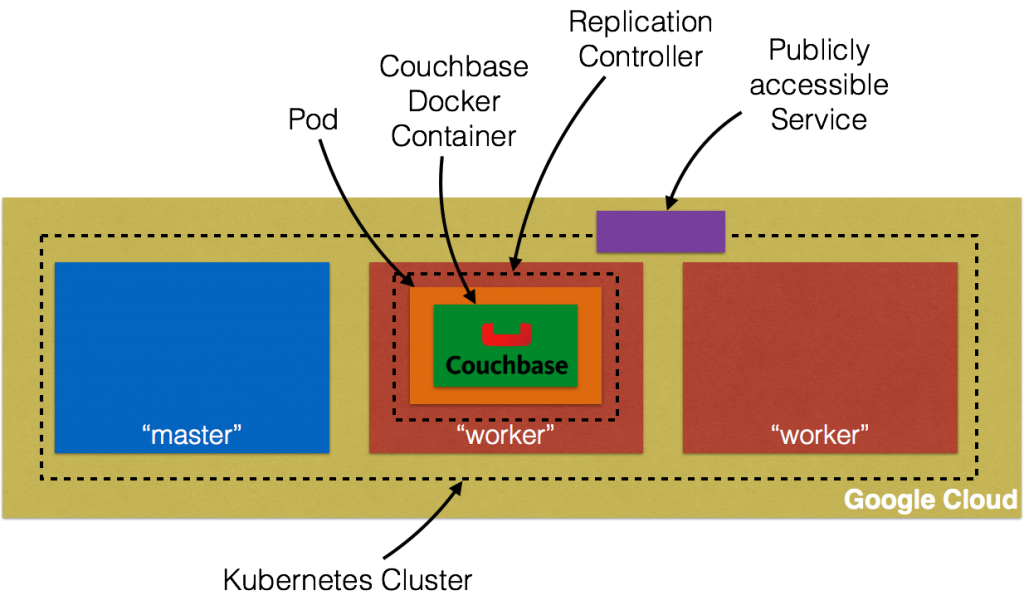
Let’s get into details!
Getting Started with Google Compute Engine provide detailed instructions on how to setup Kubernetes on Google Cloud.
Download and Configure Google Cloud SDK
There is a bit of setup required if you’ve never accessed Google Cloud on your machine. This was a bit overwhelming and wish can be simplified.
- Create a billable account on Google Cloud
- Instalar Google Cloud SDK
- Configure credentials: gcloud auth login
- Create a new Google Cloud project and name it
couchbase-on-kubernetes - Set the project:
gcloud config set project couchbase-on-kubernetes - Set default zone:
gcloud config set compute/zone us-central1-a - Create an instance:
gcloud compute instances create example-instance --machine-type n1-standard-1 --image debian-8 - SSH into the instance:
gcloud compute ssh example-instance - Delete the instance:
gcloud compute instances delete example-instance
Setup Kubernetes Cluster on Google Cloud
Kubernetes cluster can be created on Google Cloud as:
|
1 2 |
definir KUBERNETES_PROVIDER=gce ./aglomerado/kube–up.sh |
Make sure KUBERNETES_PROVIDER is either set to gce or not set at all. By default, this provisions a 4 node Kubernetes cluster with one master. This means 5 Virtual Machines are created.
If you downloaded Kubernetes from github.com/kubernetes/kubernetes/releases, then all the values can be changed in cluster/aws/config-default.sh.
Starting Kubernetes on Google Cloud shows the following log. Google Cloud SDK was behaving little weird but taking the defaults seem to work:
|
1 2 3 4 5 6 7 8 9 10 11 12 13 14 15 16 17 18 19 20 21 22 23 24 25 26 27 28 29 30 31 32 33 34 35 36 37 38 39 40 41 42 43 44 45 46 47 48 49 50 51 52 53 54 55 56 57 58 59 60 61 62 63 64 65 66 67 68 69 70 71 72 73 74 75 76 77 78 79 80 81 82 83 84 85 86 87 88 89 90 91 92 93 94 95 96 97 98 99 100 101 102 103 104 105 106 107 108 109 110 111 112 113 114 115 116 117 118 119 120 121 122 123 124 125 126 127 128 129 130 131 132 133 134 135 136 137 138 139 140 141 142 143 144 145 146 147 148 149 150 151 152 153 154 155 156 157 158 159 160 161 162 163 164 165 166 167 168 169 170 171 172 173 174 175 176 177 178 179 180 181 182 183 |
./Kubernetes/aglomerado/kube–up.sh ... Starting aglomerado usando provider: gce ... calling verify–prereqs You have specified individual components para update. If you are trying para instalar novo components, use: $ gcloud components instalar alpha Do you want para correr instalar instead (y/N)? Your atual Cloud SDK versão is: 99.0.0 Installing components de versão: 99.0.0 ┌──────────────────────────────────────────────┐ │ These components will be installed. │ ├───────────────────────┬────────────┬─────────┤ │ Name │ Version │ Size │ ├───────────────────────┼────────────┼─────────┤ │ gcloud Alpha Commands │ 2016.01.12 │ < 1 MiB │ └───────────────────────┴────────────┴─────────┘ For the mais recente full release notes, please visit: https://cloud.google.com/sdk/release_notes Do you want para continue (Y/n)? ╔════════════════════════════════════════════════════════════╗ ╠═ Creating update staging area ═╣ ╠════════════════════════════════════════════════════════════╣ ╠═ Installing: gcloud Alpha Commands ═╣ ╠════════════════════════════════════════════════════════════╣ ╠═ Creating backup e activating novo installation ═╣ ╚════════════════════════════════════════════════════════════╝ Performing post processing etapas...done. Update done! You have specified individual components para update. If you are trying para instalar novo components, use: $ gcloud components instalar beta Do you want para correr instalar instead (y/N)? Your atual Cloud SDK versão is: 99.0.0 Installing components de versão: 99.0.0 ┌─────────────────────────────────────────────┐ │ These components will be installed. │ ├──────────────────────┬────────────┬─────────┤ │ Name │ Version │ Size │ ├──────────────────────┼────────────┼─────────┤ │ gcloud Beta Commands │ 2016.01.12 │ < 1 MiB │ └──────────────────────┴────────────┴─────────┘ For the mais recente full release notes, please visit: https://cloud.google.com/sdk/release_notes Do you want para continue (Y/n)? ╔════════════════════════════════════════════════════════════╗ ╠═ Creating update staging area ═╣ ╠════════════════════════════════════════════════════════════╣ ╠═ Installing: gcloud Beta Commands ═╣ ╠════════════════════════════════════════════════════════════╣ ╠═ Creating backup e activating novo installation ═╣ ╚════════════════════════════════════════════════════════════╝ Performing post processing etapas...done. Update done! All components are up para date. ... calling kube–up Your active configuration is: [default] Project: Couchbase–ligado–Kubernetes Zone: us–central1–b Creating gs://kubernetes-staging-9479406781 Creating gs://kubernetes-staging-9479406781/… +++ Staging server tars para Google Storage: gs://kubernetes-staging-9479406781/devel +++ Kubernetes–server–Linux–amd64.alcatrão.parabéns uploaded (sha1 = 1ff42f7c31837851d919a66fc07f34b9dbdacf28) +++ Kubernetes–salt.alcatrão.parabéns uploaded (sha1 = f307380ad6af7dabcf881b132146fa775c18dca8) Looking para already existing resources Starting master e configuring firewalls Created [https://www.googleapis.com/compute/v1/projects/couchbase-on-kubernetes/zones/us-central1-b/disks/kubernetes-master-pd]. NAME ZONE SIZE_GB TYPE STATUS Kubernetes–master–pd us–central1–b 20 pd–ssd READY Created [https://www.googleapis.com/compute/v1/projects/couchbase-on-kubernetes/regions/us-central1/addresses/kubernetes-master-ip]. Created [https://www.googleapis.com/compute/v1/projects/couchbase-on-kubernetes/global/firewalls/default-default-ssh]. Created [https://www.googleapis.com/compute/v1/projects/couchbase-on-kubernetes/global/firewalls/kubernetes-master-https]. NAME NETWORK SRC_RANGES RULES SRC_TAGS TARGET_TAGS default–default–ssh default 0.0.0.0/0 tcp:22 NAME NETWORK SRC_RANGES RULES SRC_TAGS TARGET_TAGS Kubernetes–master–https default 0.0.0.0/0 tcp:443 Kubernetes–master +++ Logging usando Fluentd para GCP ./Kubernetes/aglomerado/../aglomerado/../aglomerado/gce/util.sh: line 434: @: unbound variável ./Kubernetes/aglomerado/../aglomerado/../aglomerado/gce/util.sh: line 434: @: unbound variável ./Kubernetes/aglomerado/../aglomerado/../aglomerado/gce/util.sh: line 434: @: unbound variável ./Kubernetes/aglomerado/../aglomerado/../aglomerado/gce/util.sh: line 434: @: unbound variável Created [https://www.googleapis.com/compute/v1/projects/couchbase-on-kubernetes/global/firewalls/default-default-internal]. NAME NETWORK SRC_RANGES RULES SRC_TAGS TARGET_TAGS default–default–internal default 10.0.0.0/8 tcp:1–65535,udp:1–65535,icmp Created [https://www.googleapis.com/compute/v1/projects/couchbase-on-kubernetes/global/firewalls/kubernetes-minion-all]. NAME NETWORK SRC_RANGES RULES SRC_TAGS TARGET_TAGS Kubernetes–minion–todos default 10.244.0.0/16 tcp,udp,icmp,esp,ah,sctp Kubernetes–minion Created [https://www.googleapis.com/compute/v1/projects/couchbase-on-kubernetes/zones/us-central1-b/instances/kubernetes-master]. NAME ZONE MACHINE_TYPE PREEMPTIBLE INTERNAL_IP EXTERNAL_IP STATUS Kubernetes–master us–central1–b n1–standard–1 10.128.0.2 104.197.213.249 RUNNING Creating minions. ./Kubernetes/aglomerado/../aglomerado/../aglomerado/gce/util.sh: line 434: @: unbound variável ./Kubernetes/aglomerado/../aglomerado/../aglomerado/gce/util.sh: line 434: @: unbound variável Attempt 1 para criar Kubernetes–minion–template WARNING: You have selected a disk size de under [200GB]. Este may result in poor I/O performance. For mais information, see: https://developers.google.com/compute/docs/disks/persistent-disks#pdperformance. Created [https://www.googleapis.com/compute/v1/projects/couchbase-on-kubernetes/global/instanceTemplates/kubernetes-minion-template]. NAME MACHINE_TYPE PREEMPTIBLE CREATION_TIMESTAMP Kubernetes–minion–template n1–standard–1 2016–03–03T14:01:14.322–08:00 Created [https://www.googleapis.com/compute/v1/projects/couchbase-on-kubernetes/zones/us-central1-b/instanceGroupManagers/kubernetes-minion-group]. NAME ZONE BASE_INSTANCE_NAME SIZE TARGET_SIZE INSTANCE_TEMPLATE AUTOSCALED Kubernetes–minion–group us–central1–b Kubernetes–minion 4 Kubernetes–minion–template Waiting para group para tornar-se stable, atual operations: creating: 4 Waiting para group para tornar-se stable, atual operations: creating: 4 Waiting para group para tornar-se stable, atual operations: creating: 4 Waiting para group para tornar-se stable, atual operations: creating: 4 Waiting para group para tornar-se stable, atual operations: creating: 4 Waiting para group para tornar-se stable, atual operations: creating: 4 Waiting para group para tornar-se stable, atual operations: creating: 3 Group is stable MINION_NAMES=Kubernetes–minion–1hmm Kubernetes–minion–3x1d Kubernetes–minion–h1ov Kubernetes–minion–nshn Using master: Kubernetes–master (externo IP: 104.197.213.249) Waiting para aglomerado initialization. Este will continually check para see if the API para Kubernetes is reachable. Este might loop forever if there was some uncaught error during start up. Kubernetes aglomerado created. aglomerado “couchbase-on-kubernetes_kubernetes” definir. usuário “couchbase-on-kubernetes_kubernetes” definir. context “couchbase-on-kubernetes_kubernetes” definir. switched para context “couchbase-on-kubernetes_kubernetes”. usuário “couchbase-on-kubernetes_kubernetes-basic-auth” definir. Wrote config para Couchbase–ligado–kubernetes_kubernetes para /Users/arungupta/.kube/config Kubernetes aglomerado is running. A master is running at: https://104.197.213.249 A usuário nome e senha para use is located in /Users/arungupta/.kube/config. ... calling validate–aglomerado Waiting para 4 ready nodes. 0 ready nodes, 0 registered. Retrying. Waiting para 4 ready nodes. 0 ready nodes, 2 registered. Retrying. Waiting para 4 ready nodes. 0 ready nodes, 3 registered. Retrying. Waiting para 4 ready nodes. 0 ready nodes, 4 registered. Retrying. Waiting para 4 ready nodes. 3 ready nodes, 4 registered. Retrying. Waiting para 4 ready nodes. 3 ready nodes, 4 registered. Retrying. Found 4 nó(s). NAME LABELS STATUS AGE Kubernetes–minion–1hmm Kubernetes.io/hostname=Kubernetes–minion–1hmm Ready 1m Kubernetes–minion–3x1d Kubernetes.io/hostname=Kubernetes–minion–3x1d Ready 52s Kubernetes–minion–h1ov Kubernetes.io/hostname=Kubernetes–minion–h1ov Ready 1m Kubernetes–minion–nshn Kubernetes.io/hostname=Kubernetes–minion–nshn Ready 1m Validate output: NAME STATUS MESSAGE ERRO controlador–manager Healthy ok nil scheduler Healthy ok nil etcd–0 Healthy {“health”: “true”} nil etcd–1 Healthy {“health”: “true”} nil Cluster validation succeeded Done, listing aglomerado serviços: Kubernetes master is running at https://104.197.213.249 GLBCDefaultBackend is running at https://104.197.213.249/api/v1/proxy/namespaces/kube-system/services/default-http-backend Heapster is running at https://104.197.213.249/api/v1/proxy/namespaces/kube-system/services/heapster KubeDNS is running at https://104.197.213.249/api/v1/proxy/namespaces/kube-system/services/kube-dns KubeUI is running at https://104.197.213.249/api/v1/proxy/namespaces/kube-system/services/kube-ui Grafana is running at https://104.197.213.249/api/v1/proxy/namespaces/kube-system/services/monitoring-grafana InfluxDB is running at https://104.197.213.249/api/v1/proxy/namespaces/kube-system/services/monitoring-influxdb |
There are a couple of unbound variables and a WARNING message, but that didn’t seem to break the script. Google Cloud Console shows: 
Five instances are created as shown – one for master node and four for worker nodes.
Run Docker Container in Kubernetes Cluster on Google Cloud
Now that the cluster is up and running, get a list of all the nodes:
|
1 2 3 4 5 6 |
./Kubernetes/aglomerado/kubectl.sh obter não NAME LABELS STATUS AGE Kubernetes–minion–1hmm Kubernetes.io/hostname=Kubernetes–minion–1hmm Ready 47m Kubernetes–minion–3x1d Kubernetes.io/hostname=Kubernetes–minion–3x1d Ready 46m Kubernetes–minion–h1ov Kubernetes.io/hostname=Kubernetes–minion–h1ov Ready 47m Kubernetes–minion–nshn Kubernetes.io/hostname=Kubernetes–minion–nshn Ready 47m |
It shows four worker nodes. Create a Couchbase pod:
|
1 2 |
./Kubernetes/aglomerado/kubectl.sh correr Couchbase —image=arungupta/Couchbase replicationcontroller “couchbase” created |
Notice, how the image name can be specified on the CLI. This command creates a Replication Controller with a single pod. The pod uses arungupta/couchbase Docker image that provides a pre-configured Couchbase server. Any Docker image can be specified here.
Get all the RC resources:
|
1 2 3 |
./Kubernetes/aglomerado/kubectl.sh obter rc CONTROLLER CONTAINER(S) IMAGE(S) SELECTOR REPLICAS AGE Couchbase Couchbase arungupta/Couchbase correr=Couchbase 1 48s |
This shows the Replication Controller that is created for you.
Get all the Pods:
|
1 2 3 |
./Kubernetes/aglomerado/kubectl.sh obter po NAME READY STATUS RESTARTS AGE Couchbase–s8v9r 1/1 Running 0 1m |
The output shows the Pod that is created as part of the Replication Controller.
Get more details about the Pod:
|
1 2 3 4 5 6 7 8 9 10 11 12 13 14 15 16 17 18 19 20 21 22 23 24 25 26 27 28 29 30 31 32 33 34 35 36 37 38 39 40 41 42 43 44 |
./Kubernetes/aglomerado/kubectl.sh describe po Couchbase–s8v9r Name: Couchbase–s8v9r Namespace: default Image(s): arungupta/Couchbase Node: Kubernetes–minion–3x1d/10.128.0.3 Start Tempo: Qui, 03 Mar 2016 14:53:36 –0800 Labels: correr=Couchbase Status: Running Reason: Message: IP: 10.244.3.3 Replicação Controllers: Couchbase (1/1 réplicas created) Containers: Couchbase: Container ID: docker://601ee2e4c822814c3969a241e37c97bf4d0d209f952f24707ab308192d289098 Image: arungupta/Couchbase Image ID: docker://298618e67e495c2535abd17b60241565e456a4c9ee96c923ecf844a9dbcccced QoS Tier: cpu: Burstable Requests: cpu: 100m State: Running Started: Qui, 03 Mar 2016 14:54:46 –0800 Ready: Verdadeiro Restart Count: 0 Environment Variables: Conditions: Tipo Status Ready Verdadeiro Volumes: default–token–frsd7: Tipo: Secret (a secret aquele should populate this volume) SecretName: default–token–frsd7 Events: FirstSeen LastSeen Count From SubobjectPath Reason Message ───────── ──────── ───── ──── ───────────── ────── ─────── 1m 1m 1 {kubelet Kubernetes–minion–3x1d} implicitly required container POD Pulled Container image “gcr.io/google_containers/pause:0.8.0” already present ligado machine 1m 1m 1 {scheduler } Scheduled Successfully assigned Couchbase–s8v9r para Kubernetes–minion–3x1d 1m 1m 1 {kubelet Kubernetes–minion–3x1d} implicitly required container POD Created Created com docker identidade c1de9da87f1e 1m 1m 1 {kubelet Kubernetes–minion–3x1d} spec.contêineres{Couchbase} Pulling Pulling image “arungupta/couchbase” 1m 1m 1 {kubelet Kubernetes–minion–3x1d} implicitly required container POD Started Started com docker identidade c1de9da87f1e 29s 29s 1 {kubelet Kubernetes–minion–3x1d} spec.contêineres{Couchbase} Pulled Successfully pulled image “arungupta/couchbase” 29s 29s 1 {kubelet Kubernetes–minion–3x1d} spec.contêineres{Couchbase} Created Created com docker identidade 601ee2e4c822 29s 29s 1 {kubelet Kubernetes–minion–3x1d} spec.contêineres{Couchbase} Started Started com docker identidade 601ee2e4c822 |
Expose Pod on Kubernetes as Service
Now that our pod is running, how do I access the Couchbase server? You need to expose it outside the Kubernetes cluster. The kubectl expose command takes a pod, service or replication controller and expose it as a Kubernetes Service.
Let’s expose the replication controller previously created and expose it:
|
1 2 |
./Kubernetes/aglomerado/kubectl.sh expose rc Couchbase —target–porto=8091 —porto=8091 —tipo=LoadBalancer service “couchbase” exposed |
Get more details about Service:
|
1 2 3 4 5 6 7 8 9 10 11 12 13 14 15 16 17 |
./Kubernetes/aglomerado/kubectl.sh describe svc Couchbase Name: Couchbase Namespace: default Labels: correr=Couchbase Selector: correr=Couchbase Tipo: LoadBalancer IP: 10.0.37.150 LoadBalancer Ingress: 104.197.118.35 Port: 8091/TCP NodePort: 30808/TCP Endpoints: 10.244.3.3:8091 Session Affinity: Nenhum Events: FirstSeen LastSeen Count From SubobjectPath Reason Message ───────── ──────── ───── ──── ───────────── ────── ─────── 2m 2m 1 {service–controlador } CreatingLoadBalancer Creating carregar balancer 1m 1m 1 {service–controlador } CreatedLoadBalancer Created carregar balancer |
A Loadbalancer Ingress attribute gives you the IP address of the load balancer that is now publicly accessible. Wait for 3 minutes to let the load balancer settle down. Access it using port 8091 and the login page for Couchbase Web Console shows up: 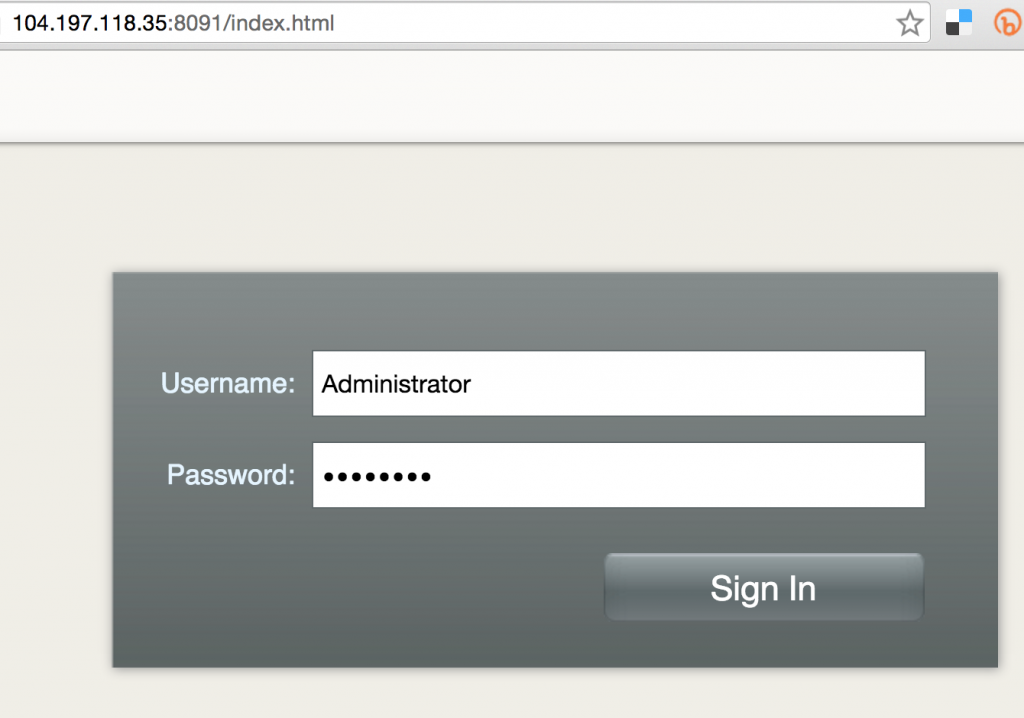
Enter the credentials as “Administrator” and “password” to see the Web Console: 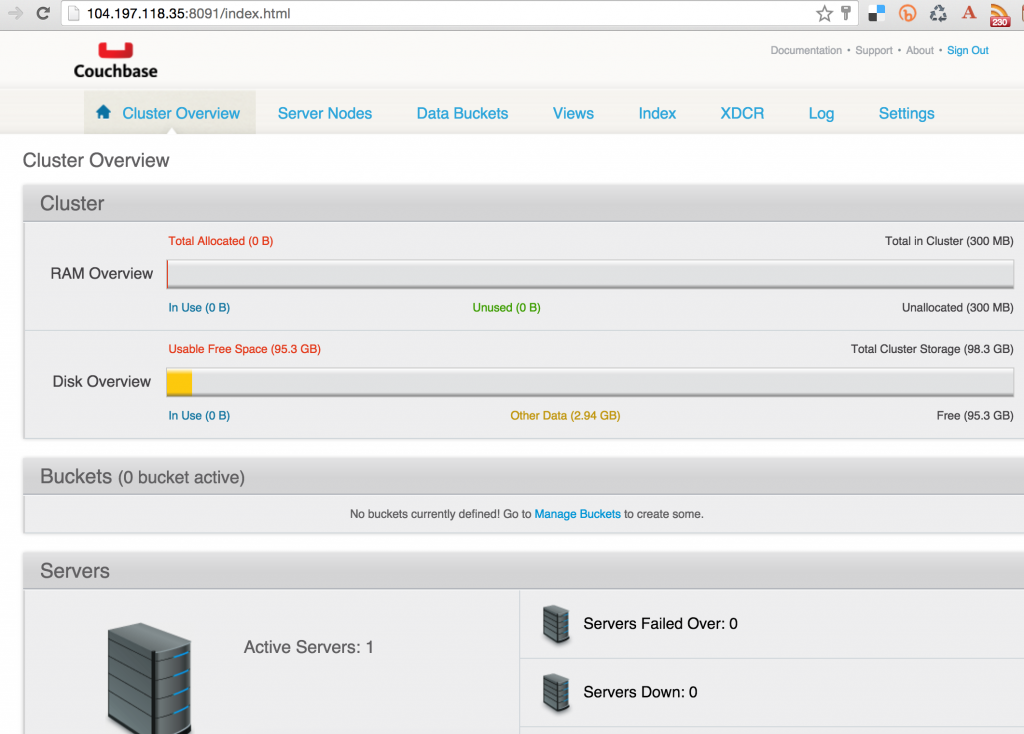
And so you just accessed your pod outside the Kubernetes cluster.
Shutdown Kubernetes Cluster
Finally, shutdown the cluster using cluster/kube-down.sh script.
|
1 2 3 4 5 6 7 8 9 10 11 12 13 14 15 16 17 18 19 20 21 22 23 24 25 26 27 28 29 30 31 32 33 34 35 36 37 38 39 40 41 |
./Kubernetes/aglomerado/kube–down.sh Bringing down aglomerado usando provider: gce You have specified individual components para update. If you are trying para instalar novo components, use: $ gcloud components instalar alpha Do you want para correr instalar instead (y/N)? All components are up para date. You have specified individual components para update. If you are trying para instalar novo components, use: $ gcloud components instalar beta Do you want para correr instalar instead (y/N)? All components are up para date. All components are up para date. Your active configuration is: [default] Project: Couchbase–ligado–Kubernetes Zone: us–central1–b Bringing down aglomerado Deleted [https://www.googleapis.com/compute/v1/projects/couchbase-on-kubernetes/zones/us-central1-b/instanceGroupManagers/kubernetes-minion-group]. Deleted [https://www.googleapis.com/compute/v1/projects/couchbase-on-kubernetes/global/instanceTemplates/kubernetes-minion-template]. Updated [https://www.googleapis.com/compute/v1/projects/couchbase-on-kubernetes/zones/us-central1-b/instances/kubernetes-master]. Deleted [https://www.googleapis.com/compute/v1/projects/couchbase-on-kubernetes/zones/us-central1-b/instances/kubernetes-master]. Deleted [https://www.googleapis.com/compute/v1/projects/couchbase-on-kubernetes/global/firewalls/kubernetes-master-https]. Deleted [https://www.googleapis.com/compute/v1/projects/couchbase-on-kubernetes/global/firewalls/kubernetes-minion-all]. Deleting routes Kubernetes–ad3beb92–e18b–11e5–8e71–42010a800002 Deleted [https://www.googleapis.com/compute/v1/projects/couchbase-on-kubernetes/global/routes/kubernetes-ad3beb92-e18b-11e5-8e71-42010a800002]. Deleted [https://www.googleapis.com/compute/v1/projects/couchbase-on-kubernetes/regions/us-central1/addresses/kubernetes-master-ip]. property “clusters.couchbase-on-kubernetes_kubernetes” unset. property “users.couchbase-on-kubernetes_kubernetes” unset. property “users.couchbase-on-kubernetes_kubernetes-basic-auth” unset. property “contexts.couchbase-on-kubernetes_kubernetes” unset. property “current-context” unset. Cleared config para Couchbase–ligado–kubernetes_kubernetes de /Users/arungupta/.kube/config Done |
Enjoy!

Deixe um comentário
Você precisa fazer o login para publicar um comentário.