

시각 언어 모델은 무엇인가요?
비전 언어 모델(VLM)은 시각 데이터와 텍스트 데이터 모두를 이해하고 추론하도록 설계된 AI 시스템입니다. 이미지만 분석하는 전통적인 컴퓨터 비전(CV) 모델이나 텍스트만 처리하는 거대 언어 모델(LLM)과 달리, VLM은 이 두 가지 양식을 연결하여 공유된 이해를 형성합니다.
VLM은 일반적으로 캡션이 달린 사진이나 시각적 요소와 언어가 혼합된 문서와 같이, 쌍을 이루는 이미지와 텍스트를 포함하는 대규모 데이터셋으로 학습됩니다. 이 학습을 통해 VLM은 시각적 특징(예: 객체, 장면, 공간적 관계)이 단어와 의미에 어떻게 매핑되는지 학습합니다. 이를 통해 모델은 이미지를 설명하고, 이미지에 대한 질문에 답하며, 언어를 사용하여 시각적 콘텐츠를 추론할 수 있습니다.
비전 언어 모델이 작동하는 방식
시각 언어 모델은 시각적 이해와 언어 이해를 하나의 시스템으로 통합합니다. 아키텍처는 다양하지만, 대부분의 VLM은 아래에 요약된 동일한 핵심 워크플로우를 따릅니다.
1. 이미지 인코딩 및 시각적 특징 추출
- 이미지는 비전 인코더, 대개 합성곱 신경망(CNN) 또는 비전 트랜스포머(ViT)에 의해 처리됩니다.
- 인코더는 객체, 모양, 질감, 공간적 관계와 같은 의미 있는 시각적 특징을 추출합니다.
- 이러한 피처들은 모델이 추론할 수 있는 수치적 표현으로 변환됩니다.
2. 텍스트 인코딩 및 언어 이해
- 텍스트 입력은 일반적으로 트랜스포머 아키텍처를 기반으로 하는 언어 인코더에 의해 처리됩니다.
- 인코더는 의미, 문맥, 그리고 단어 간의 관계를 포착합니다.
- 출력은 시각적 개념과 일치하는 언어의 구조화된 표현입니다.
3. 시각과 언어 간의 교차 모달 정렬
- 이 모델은 이미지와 텍스트 표현을 공통 임베딩 공간으로 매핑하는 것을 학습합니다.
- 이 공간에서 관련된 이미지와 텍스트는 더 가깝게 배치되고, 관련 없는 쌍은 서로 멀어집니다.
- 이러한 정렬은 이미지 캡셔닝, 시각적 질의 응답(VQA), 이미지-텍스트 검색과 같은 작업을 가능하게 합니다.
- CLIP과 같은 모델은 대규모로 강력한 이미지-텍스트 정렬을 학습하는 것으로 잘 알려져 있습니다.
4. VLM의 훈련 대 추론
- 훈련:
- 이 모델은 쌍을 이루는 이미지와 텍스트(예: 캡션, 설명, 문서 등)의 대규모 데이터셋으로 학습되었습니다.
- 목표는 모델이 이미지를 관련 언어와 올바르게 연결하도록 유도합니다.
- 추론
- 일단 훈련되면, 모델은 학습한 내용을 새로운 입력에 적용합니다.
- 추가적인 학습 없이 이미지를 해석하고, 질문에 답하며, 설명을 생성하거나, 관련 콘텐츠를 검색할 수 있습니다.
시각 언어 모델 대 전통적 컴퓨터 비전 모델 대 거대 언어 모델
세 모델 유형 모두 광범위한 AI 우산 아래에 속하지만, 매우 다른 목적을 위해 설계되었습니다. 핵심적인 차이점은 어떤 데이터를 처리할 수 있는지, 어떻게 추론하는지, 그리고 어떤 종류의 작업에 가장 적합한지에 있습니다. 이러한 차이점을 이해하면 팀이 올바른 문제에 적합한 모델을 선택하는 데 도움이 됩니다. 다음은 주요 차이점을 간략하게 비교한 것입니다.
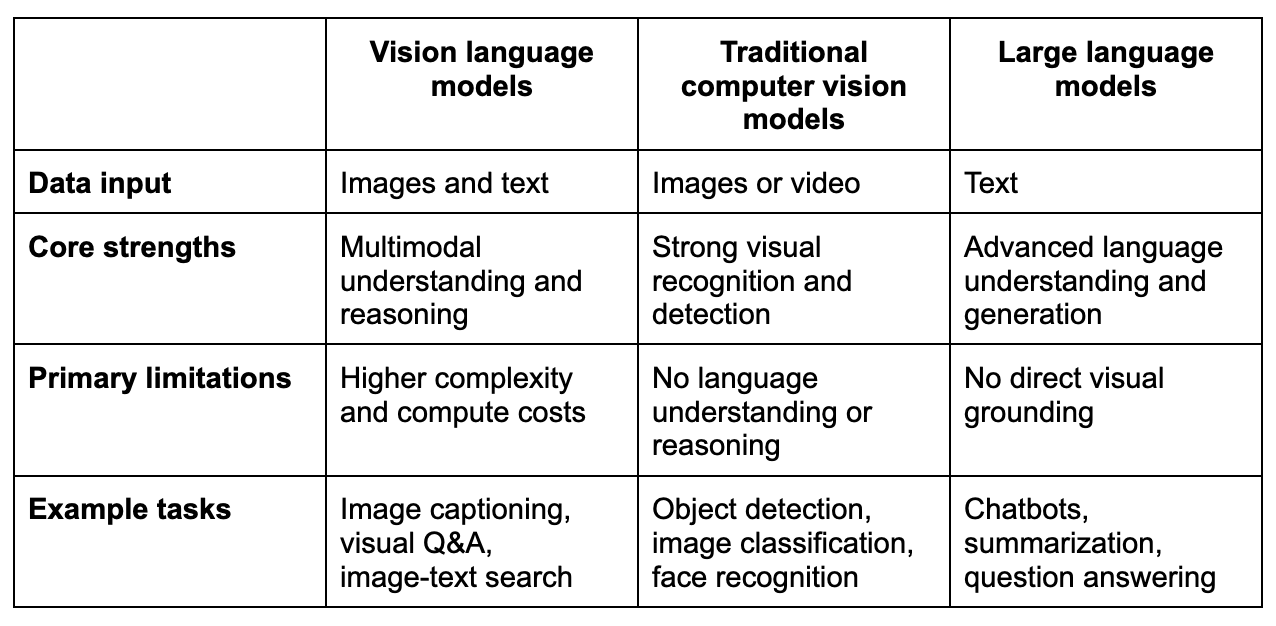
주요 차이점 설명
- 기존의 컴퓨터 비전 모델은 시각적 신호에만 독점적으로 초점을 맞추고 이미지에 있는 내용을 식별하는 데 최적화되어 있지만, 자연어로 설명하는 데는 그렇지 않습니다.
- LLM은 텍스트 추론에는 탁월하지만, 시각적 맥락이 설명되지 않는 한 이를 인식하지 못합니다.
- VLM은 컴퓨터 비ジョン(CV) 모델과 거대 언어 모델(LLM) 사이의 간극을 메워, 이미지와 텍스트 양쪽 모달리티 전반에 걸쳐 그라운디드 리소닝(Grounded Reasoning)을 가능하게 합니다.
CLIP과 같은 잘 알려진 VLM은 학습합니다 이미지와 언어 정렬, 반면 GPT-5의 멀티모달 버전은 이 기능을 보다 일반적인 추론 및 상호작용으로 확장합니다.
비전 언어 모델(VLM)과 단일 모달 모델을 언제 사용해야 하는가
시각 언어 모델을 사용하는 경우:
- 이 작업은 이미지와 텍스트를 함께 이해해야 합니다.
- 사용자는 시각적 콘텐츠에 기반한 설명, 답변 또는 추론이 필요합니다.
- 응용 프로그램에는 멀티모달 검색, 문서 이해 또는 시각적 보조가 포함됩니다.
다음의 경우 전통적인 컴퓨터 비전 모델을 사용하세요:
- 해당 작업은 시각적인 작업입니다 (예: 결함 감지, 객체 카운팅 등).
- 속도, 효율성 또는 엣지 배포가 매우 중요합니다
- 언어 기반 추론이나 설명은 필요하지 않습니다.
다음의 경우 대규모 언어 모델을 사용하세요:
- 이 문제는 텍스트만 포함합니다 (예: 요약, 콘텐츠 생성).
- 시각적 맥락은 불필요하거나 이미 텍스트에 인코딩되어 있습니다.
- 유연한 자연어 추론이 필요합니다
주요 기능 및 업무
The ability to jointly understand visual content and natural language allows VLMs to interpret, reason, and interact with images in ways that are more flexible and human-like, such as:
Image captioning
VLMs can generate natural language descriptions of images by identifying objects, actions, and relationships within a scene. This capability is commonly used for accessibility tools, content moderation, and media management.
Visual question answering
Visual question answering allows users to ask questions about an image and receive relevant, context-aware answers. The model must understand both the visual content and the intent behind the question to respond accurately.
Image-text retrieval
VLMs support cross-modal search by matching images to text and vice versa. This enables use cases such as finding products based on descriptions or retrieving relevant images using natural language queries.
Multimodal reasoning
VLMs can reason across visual and textual inputs to draw conclusions, compare elements, or follow instructions grounded in images. This capability is critical for complex tasks like visual assistance and decision support.
Document and scene understanding
VLMs can interpret documents and real-world scenes that combine text and visuals, such as forms, diagrams, screenshots, or street images. This enables applications like document analysis, workflow automation, and environment-aware systems.
Use cases for vision language models
By combining modalities, VLMs enable richer interactions, better automation, and more accurate insights across many industries where understanding both visual content and language is essential. Common use cases include:
- Visual search and discovery: Enable users to search for products, images, or content using natural language descriptions instead of keywords.
- Customer support and troubleshooting: Interpret screenshots or photos submitted by users to provide faster, more accurate assistance.
- Document processing and analysis: Extract meaning from documents that combine text, tables, charts, and images, such as invoices, contracts, and reports.
- Accessibility tools: Generate image descriptions and answer visual questions to support users with visual impairments.
- Healthcare and medical imaging: Analyze medical images alongside clinical notes to support diagnosis, documentation, and research.
- Retail and e-commerce: Power visual product recommendations, image-based search, and automated catalog tagging.
- Autonomous systems and robotics: Help machines understand their environment and follow language-based instructions grounded in visual context.
- Content moderation and safety: Identify and interpret visual content alongside text to enforce policies more accurately.
Training data and architectures
Vision language models rely on large-scale multimodal data and specialized architectures to learn the relationships between images and language. The quality of the data and the design of the model architecture play a critical role in how well a VLM performs across tasks.
Training data for vision language models
Vision language models require diverse training data to capture both broad multimodal knowledge and task-specific or domain-specific relationships between images and text. This data includes:
- Image-text pairs: The most common training data format, where images are paired with captions, descriptions, or surrounding text
- Web-scale datasets: Large collections of publicly available images and text used to learn broad visual and linguistic concepts
- Annotated datasets: Carefully labeled data for tasks like visual question answering, document understanding, or scene interpretation
- Domain-specific data: Specialized datasets (e.g., medical images with clinical notes or product images with metadata) used to improve performance in specific industries
Common VLM architectures
Several architectural paradigms have emerged for vision language models, each balancing efficiency, flexibility, and reasoning capability in different ways:
- Dual-encoder models:
- Use separate encoders for images and text
- Learn to align visual and language representations in a shared embedding space
- Well suited for retrieval tasks and scalable training (e.g., CLIP)
- Encoder-decoder models:
- Encode visual inputs and generate text outputs directly
- Commonly used for image captioning and visual question answering (e.g., BLIP)
- Unified multimodal models:
- Process images and text together within a single transformer-based architecture
- Enable advanced multimodal reasoning and flexible task handling
Role of transformers and attention mechanisms
- Transformer architectures allow models to attend to relevant parts of both images and text.
- Attention mechanisms help the model understand relationships between visual regions and words or phrases.
- This design is key to enabling complex reasoning across modalities.
Limitations of vision language models
While vision language models unlock powerful multimodal capabilities, they also come with important limitations that teams should understand before deploying them in real-world applications.
- Data quality and bias: VLMs are trained on large image-text datasets that may contain noise, inaccuracies, or societal biases, which can affect model outputs and fairness.
- High computational cost: Training and running VLMs requires significant compute resources, making them expensive to build, deploy, and scale.
- Limited visual grounding: Models may generate confident but incorrect responses if visual details are subtle, ambiguous, or outside their training distribution.
- Generalization challenges: Performance can drop when models encounter unfamiliar domains, image styles, or real-world scenarios that aren’t well represented in training data.
- Interpretability issues: It’s often difficult to understand why a VLM produced a specific output, which can be problematic in regulated or high-stakes settings.
- Latency constraints: The complexity of multimodal processing can introduce delays, limiting suitability for real-time or edge applications.
- Ethical and privacy concerns: Using images that include people, private spaces, or sensitive information raises privacy, consent, and misuse risks.
Recognizing these limitations is essential for applying vision language models responsibly and for selecting appropriate safeguards, evaluation methods, and use cases.
Evaluation and performance metrics
Evaluating vision language models requires measuring both visual understanding and language performance, often across multiple tasks. Because many VLM outputs are open-ended, effective evaluation typically combines automated metrics with human judgment.
Task-specific metrics
Depending on the specific task formulation, standard predictive performance metrics include:
- Accuracy: Commonly used for classification-style tasks such as visual question answering with fixed answer sets
- Precision, recall, and F1 score: Measure how well the model identifies relevant outputs, especially in retrieval or detection tasks
- Top-k accuracy: Evaluates whether the correct answer appears among the model’s top predictions
Generation quality metrics
For tasks where the model generates free-form text, specialized metrics include:
- BLEU: Measures overlap between generated text and reference captions or answers, often used for image captioning and translation tasks
- ROUGE: Focuses on recall and is commonly applied to summarization-style outputs
- CIDEr and METEOR: Designed specifically for evaluating image captions by comparing them to multiple human references
Retrieval and alignment metrics
When the goal is to evaluate how well models associate images and text, metrics include:
- Recall@K: Assesses how often the correct image or text is retrieved within the top K results
- Mean reciprocal rank (MRR): Evaluates ranking quality in image-text retrieval tasks
- Cross-modal similarity scores: Measure how well image and text embeddings align in shared representation spaces
Human evaluation
Because automated metrics can lack nuance, human judgment is often incorporated to provide a more holistic assessment of model behavior.
- Human reviewers assess qualities that automated metrics struggle to capture, such as correctness, relevance, reasoning, and fluency.
- Human evaluation is especially important for multimodal reasoning and open-ended generation tasks.
Operational performance metrics
Beyond output quality, practical deployment also requires evaluating how efficiently models perform under real-world system constraints, 예를 들면:
- Latency: Time required to process image-text inputs and generate outputs
- Throughput: Number of requests handled over a given time period
- Resource usage: Memory and compute requirements during inference
A balanced evaluation strategy ensures that vision language models are accurate, reliable, and practical to deploy.
Future trends in vision language models
Vision language models are continuing to evolve as research pushes beyond basic image-text alignment toward deeper understanding, reasoning, and real-world interaction. Several key trends are shaping the next generation of VLM capabilities. Some of these include:
- Stronger multimodal reasoning: Models will move beyond merely describing images to performing step-by-step reasoning grounded in visual evidence, enabling more reliable decision-making and analysis.
- Unified multimodal architectures: Future VLMs are likely to handle images, text, video, audio, and other modalities within a single cohesive model rather than in separate components.
- Better grounding and reliability: Research is increasingly focused on reducing hallucinations and improving how models tie their outputs directly to visual inputs.
- More efficient training and inference: Advances in model compression, distillation, and hardware optimization will lower costs and make VLMs more practical at scale and on edge devices.
- Domain-specialized VLMs: Expect more models trained or fine-tuned for specific industries such as healthcare, finance, manufacturing, and scientific research.
- Integration with agents and tools: VLMs will increasingly be combined with autonomous agents, allowing systems to perceive environments, plan actions, and interact with the world using both vision and language.
- Greater emphasis on ethics and governance: As adoption grows, transparency, privacy protection, and bias mitigation will become central to VLM development and deployment.
Together, these trends point toward vision language models becoming a foundational layer for multimodal AI systems that can see, understand, reason, and act more like humans in complex environments.
주요 시사점 및 관련 자료
Vision language models represent a major step forward in AI by unifying visual understanding and natural language reasoning within a single system. By learning from paired image-text data and aligning vision and language in shared representations, VLMs enable interactions that are more flexible, context aware, and human-like across a wide range of applications.
주요 내용
- Vision language models are designed to jointly understand images and text, unlike traditional computer vision models or large language models that operate on a single modality.
- VLMs learn the relationships between visual features and language by training on large datasets of paired images and text.
- Most vision language models rely on separate vision and language encoders that are aligned in a shared representation space.
- Models such as CLIP demonstrate that large-scale image-text alignment enables strong multimodal retrieval and reasoning.
- Vision language models are especially effective for tasks that require multimodal understanding, including image captioning, visual question answering, and document or scene interpretation.
- Despite their capabilities, VLMs face significant limitations in data quality, bias, computational cost, generalization, and interpretability.
- Continued advances in architectures, efficiency, and grounding are positioning vision language models as a foundational component of future multimodal AI systems.
To learn more about topics related to AI advancements, you can visit the related resources below:
관련 리소스
- A Complete Guide to the AI App Development Process – Blog
- Build Your First Open Source AI Agent With Couchbase – Blog
- App Development Costs (A Breakdown) – Blog
- A Guide to AI Data Management – Blog
- An Overview of Unstructured Data Analysis – Blog
자주 묻는 질문
How are vision language models trained and evaluated? Vision language models are trained on large-scale paired image-text datasets, and are evaluated on benchmark tasks such as image-text retrieval, visual question answering, captioning, and multimodal reasoning.
How do vision language models understand the relationship between images and text? They learn to map visual and textual inputs into a shared 임베딩 space where related images and text are positioned close together, enabling alignment and reasoning across modalities.
How do vision language models handle multimodal inputs? VLMs process images and text through separate encoders, then combine their representations using attention mechanisms or shared architectures to jointly reason over both inputs.
Are vision language models suitable for real-time or edge applications? They can be used in real time for some applications, but high computational costs and latency often require optimization, smaller models, or cloud-based deployment rather than edge devices.
What ethical or privacy concerns are associated with vision language models? Key concerns include bias inherited from training data, misuse of images containing people or sensitive information, and challenges related to consent, surveillance, and data privacy.
How can businesses get started with vision language models? Businesses can begin by experimenting with pretrained models or APIs, identifying high-impact multimodal use cases, and gradually fine-tuning or integrating VLMs based on their data, infrastructure, and compliance needs.

댓글 남기기
댓글을 달기 위해서는 로그인해야합니다.