

요약
앱 개발 비용을 산정하는 것은 개발 과정의 초기 단계에서 매우 중요한 단계입니다. 일부 앱의 개발 비용은 $5,000에 불과한 반면, 다른 앱은 $1백만 이상이 들기도 하기 때문입니다. 앱 유형, 기능, 위치, 개발 팀 규모, 보안 요구 사항, 사용자 인터페이스 디자인과 같은 핵심 요소들이 모두 비용에 영향을 미칩니다. 기능별 비용을 상세하게 분석해 주는 계산기를 활용하면 비용을 추정할 수 있습니다. 또한, 장기적인 지속 가능성을 확보하기 위해 지속적인 유지보수, 개발 단계, 인력 채용 비용 등을 고려해야 합니다. 이러한 요소들을 신중하게 평가함으로써, 정보에 입각한 결정을 내리고 예산 범위 내에서 성공적인 앱을 개발할 수 있습니다.
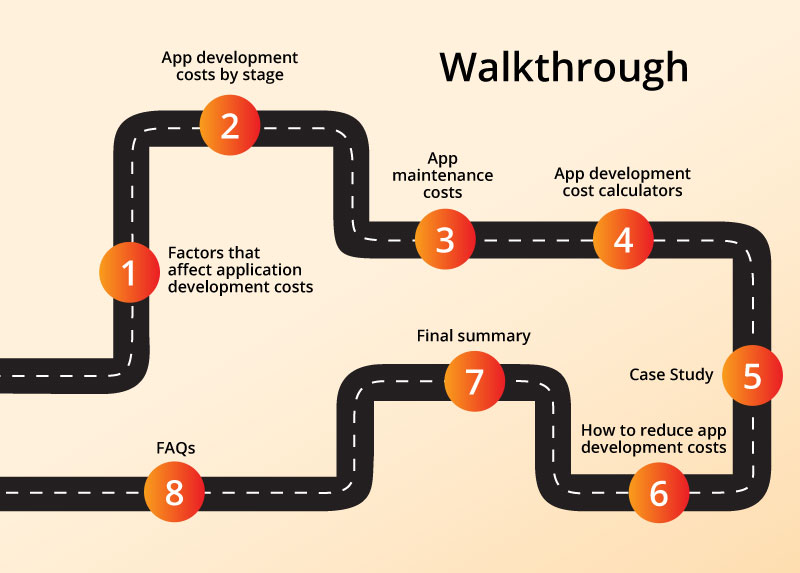
앱을 개발하는 데 비용이 얼마나 드나요?
앱 개발은 매우 수익성이 좋을 수 있지만, 앱 개발 비용은 앱의 복잡성과 필요한 기능 및 사양에 따라 크게 달라질 수 있습니다.
- 계산기나 손전등 앱과 같이 기본적인 기능만 갖춘 간단한 앱의 개발 비용은 $10,000에서 $100,000 이상까지 들 수 있습니다.
- 소셜 미디어와 같은 더 복잡한 앱이나 이커머스 앱, 가격은 $100,000에서 $500,000 이상까지 다양할 수 있습니다.
- 복잡한 기능과 엔터프라이즈급 기능을 갖춘 고급 앱(예: 뱅킹 또는 의료 보건 앱의 가격은 $500,000 이상일 수 있으며, 가장 첨단 애플리케이션의 경우 수백만 달러에 달하기도 합니다.
모바일 애플리케이션 개발 비용
모바일 앱 개발 비용은 iOS와 Android 중 어떤 플랫폼을 선택하느냐보다는 앱의 기능, 백엔드 서비스, 연동 기능, 보안 요구 사항에 더 크게 좌우됩니다. 일반적인 기준으로 볼 때, 출시 준비가 완료된 iOS 또는 Android 앱의 비용은 대개 $40,000에서 $150,000 사이이며, 두 운영 체제 모두를 지원하는 크로스-플랫폼 모바일 앱의 경우 일반적으로 $60,000에서 $250,000 사이입니다.
React Native 및 Flutter와 같은 크로스플랫폼 프레임워크는 iOS와 안드로이드 간에 애플리케이션 코드베이스의 상당 부분을 공유할 수 있도록 함으로써 개발 시간과 비용을 크게 줄일 수 있습니다. 그러나 고급 기기 기능, 고성능 그래픽 또는 광범위한 플랫폼별 기능이 필요한 앱의 경우 여전히 네이티브 개발이 유리할 수 있습니다.
웹 애플리케이션 개발 비용
웹 애플리케이션 개발 비용은 애플리케이션의 기능에 따라 크게 달라집니다. 간단한 정보 제공 웹사이트나 기본적인 비즈니스 포털의 경우 $10,000에서 $40,000 정도의 비용이 소요될 수 있는 반면, 사용자 계정, 데이터베이스, API, 타사 서비스 연동 기능을 갖춘 풀스택 웹 애플리케이션의 경우 일반적으로 $50,000에서 $250,000 사이의 비용이 소요됩니다. 고급 워크플로우, 보안, 규정 준수 및 높은 확장성을 갖춘 엔터프라이즈 웹 플랫폼의 경우 $250,000에서 $1백만 이상을 훨씬 넘는 비용이 소요될 수 있습니다.
궁극적으로 웹 앱 개발 비용은 기술 스택 자체보다는 애플리케이션의 복잡성, 백엔드 아키텍처, 연동 및 지속적인 인프라 요구사항에 의해 더 좌우됩니다.
앱 개발 비용이 일회성 지출이 아니라는 점도 중요합니다. 지속적인 유지 관리, 업데이트 및 개선에도 추가적인 시간과 자원이 필요합니다.
AI 앱을 개발하는 데 비용이 얼마나 드나요?
의 비용 AI 앱 개발하기 복잡도, AI 기능, 개발 방식 및 인프라 요구 사항에 따라 달라집니다. 챗봇이나 간단한 이미지 인식 도구와 같은 기본적인 AI 기반 앱의 비용은 일반적으로 $20,000에서 $100,000 사이입니다. 이러한 앱은 대개 OpenAI의 GPT나 Google의 Vision AI와 같은 사전 구축된 머신러닝 모델과 타사 API를 활용하므로 개발 비용을 절감하는 데 도움이 됩니다. 이러한 애플리케이션의 주요 비용 항목으로는 UI/UX 디자인, API 통합, 기본 테스트 등이 있습니다.
맞춤형 머신러닝 모델, 더 고급 자연어 처리(NLP), 또는 예측 분석 일반적으로 $100,000에서 $500,000 사이의 범위를 보입니다. 이러한 앱은 상당한 양의 데이터 수집, 전처리 및 모델 훈련을 필요로 하기 때문에 비용이 증가합니다. 또한, 대규모 데이터셋을 처리하고 AI 모델을 배포하기 위해서는 Amazon Web Services(AWS), Google Cloud, Microsoft Azure와 같은 클라우드 컴퓨팅 서비스가 필요할 수 있으며, 이로 인해 서버 및 확장 비용이 추가됩니다.
딥러닝 기능을 갖춘 고도로 진화된 AI 앱, 실시간 처리, 또는 정교한 자동화 시스템의 비용은 $500,000에서 $2+백만 사이입니다. 이러한 애플리케이션은 대개 광범위한 연구개발(R&D), 지속적인 모델 개선, 대규모 인프라 지원을 수반합니다. AI 기반 의료, 금융, 또는 자율 애플리케이션 높은 정확도, 규제 준수, 그리고 지속적인 유지보수가 필요하며, 이 모든 요소가 비용을 상승시킵니다. AI 애플리케이션의 장기적인 지출에는 기술 발전에 맞춰 모델 재학습, 알고리즘 최적화, 소프트웨어 업데이트도 포함됩니다.
앱 개발 비용 요소
애플리케이션 개발 비용은 개발되는 애플리케이션의 유형, 개발이 진행되는 지역, 앱 개발자 고용, 그리고 숨겨진 비용을 포함한 다양한 요인의 영향을 받을 수 있습니다. 각 요인을 아래에 강조했습니다:
앱 유형 및 복잡도
개발 중인 애플리케이션의 유형은 맞춤형 앱 개발 비용에 상당한 영향을 미칠 수 있습니다. 예를 들어, 모바일 앱은 일반적으로 iOS와 Android 양쪽 모두를 위한 개발이 필요하며, 이는 복잡성과 비용을 증가시킬 수 있습니다. 일반적으로 앱은 다음과 같은 범주와 예시로 나눌 수 있습니다.
- 소셜 미디어 앱: 페이스북, 인스타그램, 트위터
- 이커머스 앱: 아마존, 세포라, 이베이
- 게임 앱: 배틀그라운드 모바일, 어몽어스, 캔디 크러시 사가
- 교육 앱: 듀오링고, 코세라, 유데미
- 건강 및 피트니스 앱: Zocdoc, Medscape, MyFitnessPal
- 여행 앱: 에어비앤비, 트립advisor, 구글 맵
- 생산성 앱: 트렐로, 에버노트, 아사나
- 주문형 앱: 우버, 리프트, 포스트메이트
앱 유형별 예상 개발 기간과 비용은 다음과 같습니다. 다음을 사용하여 예산을 세부적으로 조정할 수 있습니다. 앱 개발 비용 계산기.
| 앱 유형 | 개발 소요 시간 예상 | 예상 비용 |
| 소셜 미디어 | 8~15개월 | $150,000-$1,000,000+ |
| 전자상거래 | 6~12개월 | $100,000-$750,000+ |
| 게이밍 | 3~18개월 이상 | $50,000-$2,000,000+ |
| 교육 | 4~8개월 | $75,000-$400,000 |
| 건강과 피트니스 | 4~8개월 | $100,000-$500,000 |
| 여행 및 환대산업 | 4~10개월 | $100,000-$500,000 |
| 생산성 | 4~8개월 | $75,000-$400,000 |
| 주문형 | 6~12개월 | $150,000-$750,000 |
개발 지역 및 팀 위치
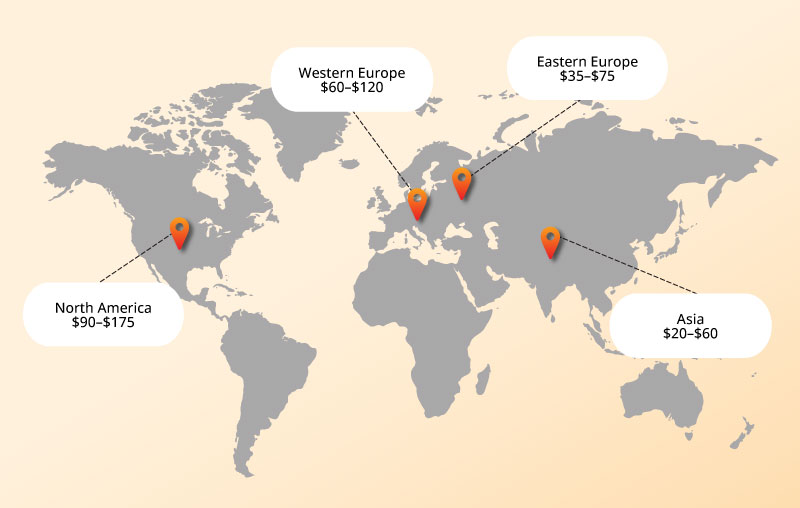
앱을 개발하는 지역도 비용에 영향을 미칠 수 있습니다. 일반적으로 북미나 서유럽과 같이 인건비가 높은 지역은 아시아나 동유럽과 같이 인건비가 낮은 지역에 비해 앱 개발 비용이 더 높은 경향이 있습니다.
- 북아메리카 그리고 서유럽: 이 지역의 개발 팀은 일반적으로 가장 높은 시간당 요금을 부과합니다.
- 동유럽: 동유럽의 개발 팀은 북미나 서유럽에 비해 시간당 임금이 낮은 경향이 있습니다.
- 아시아: 인도, 중국, 필리핀 등의 국가에 위치한 개발 팀은 일반적으로 가장 낮은 시간당 요금을 부과합니다.
아래에서 지역별 앱 개발자의 평균 시간당 급여를 확인할 수 있습니다.
해외 위탁 개발은 인건비를 크게 절감할 수 있지만, 가장 낮은 시간당 요금이 항상 가장 낮은 총 프로젝트 비용으로 이어지는 것은 아닙니다. 의사소통, 시간대 차이, 언어 구사 능력, 프로젝트 관리 오버헤드, 그리고 비즈니스 도메인에 대한 이해도와 같은 요인들은 모두 개발 속도와 제품 품질에 영향을 미칠 수 있습니다.
국내(온쇼어) 팀은 일반적으로 가장 원활한 협업과 소통을 제공하지만 비용이 가장 높습니다. 인근 해외(니어쇼어) 팀은 대개 비용, 품질, 시간대 일치 측면에서 좋은 균형을 제공합니다. 원거리 해외(오프쇼어) 팀은 보통 시간당 비용이 가장 낮지만 언어, 문화, 시간대 차이로 인해 더 많은 조율이 필요할 수 있습니다. 가장 좋은 선택은 예산, 프로젝트 복잡성, 그리고 애플리케이션에 필요한 협업 수준에 따라 달라집니다.
사내 인력 vs. 프리랜서 vs. 대행사
경험이 풍부하고 숙련된 개발자는 대개 비용이 더 많이 들지만 더 높은 품질의 최종 결과물을 보장할 수 있습니다. 반면, 경험이 적은 개발자를 고용하면 비용은 절감될 수 있지만 완성도가 떨어지는 결과물로 이어질 수도 있습니다. 다음은 사내 개발자 고용과 프리랜서 고용에 따른 비용을 간략하게 비교한 것입니다.
사내 개발자: 앱을 구축하기 위해 사내 개발 팀을 고용하는 것은 가장 비용이 많이 드는 옵션 중 하나가 될 수 있습니다. 평균 급여 미국 앱 개발자의 연봉은 약 $121,983입니다.
- 프리랜서: 프리랜서 개발자를 고용하는 것은 소규모 프로젝트나 특정 전문 지식이 필요할 때 비용 효율적인 선택이 될 수 있습니다. ~에 따르면 업워크, 프리랜서 앱 개발자의 평균 시간당 요금은 약 $13에서 $60 사이입니다.
- 개발 대행사: 개발 대행사를 고용할 경우 일반적으로 시간당 $150에서 $300의 비용이 들지만, 여기에는 프로젝트 관리, 품질 보증(QA), 디자인 등의 추가 혜택이 포함됩니다.
궁극적으로 채용 옵션의 선택은 예산, 프로젝트 요구 사항, 그리고 개발 과정에 대한 참여 수준에 따라 달라집니다. 앱 개발 비용과 품질에 영향을 미칠 수 있는 결정을 내리기 전에 모든 옵션을 신중하게 검토하는 것이 중요합니다.
숨겨진 앱 개발 비용
숨겨진 앱 개발 비용은 앱 개발 과정에서 즉시 드러나지 않을 수 있는 지출입니다. 이러한 비용은 종종 간과되거나 과소평가될 수 있지만, 앱 개발의 전체 비용에 큰 영향을 미칠 수 있습니다. 숨겨진 앱 개발 비용의 예는 다음과 같습니다:
- 백엔드 인프라: 앱을 구축하는 것은 단순히 사용자 인터페이스를 만드는 것 이상의 작업이 필요합니다. 앱이 원활하고 효율적으로 작동하도록 하려면 강력한 백엔드 인프라가 필수적입니다. 이를 유지 관리하는 데는 서버 호스팅, 데이터베이스 관리 및 기타 관련 비용이 수반될 수 있습니다.
- 타사 서비스와의 연동: 많은 앱이 결제 게이트웨이, 소셜 미디어 플랫폼, API 등 타사 서비스와의 통합을 필요로 합니다. 이러한 서비스를 통합하는 과정에서 라이선스 비용이나 API 사용료와 같은 추가 비용이 발생할 수 있습니다.
- 보안 기능: 보안은 모든 앱 개발 프로젝트에서 최우선 순위가 되어야 합니다. 그러나 암호화, 2단계 인증, 상호 TLS 인증과 같은 보안 기능을 구현하는 것은 추가 비용을 발생시킬 수 있습니다.
- 앱스토어 수수료: Apple의 App Store나 Google Play 같은 앱 스토어를 통해 앱을 배포할 계획이라면, 이러한 플랫폼에 수수료를 지불해야 합니다. 이러한 수수료에는 앱 제출, 업데이트, 호스팅 비용이 포함될 수 있습니다.
- 유지보수 및 업데이트: 앱을 출시한 후에는 원활한 실행을 유지하고 버그나 문제를 해결하기 위해 지속적인 유지 관리와 업데이트가필요합니다. 유지 관리에는 엔지니어링 지원 시간 비용, 서버 비용 및 기타 관련 비용이 포함될 수 있습니다.
- 마케팅: 프로모션과 광고는 타겟 오중언어에 도달하고 성공적인 앱을 만드는 데 도움이 됩니다.
앱 개발 프로젝트의 예산을 낼 때 앱의 총비용을 포괄적으로 이해할 수 있도록 이러한 숨겨진 앱 개발 비용을 염두에 두는 것이 중요합니다.
단계별 앱 개발 비용 분석
성공적인 앱을 만드는 것은 보기보다 더 복잡합니다. 그것은 기획, 디자인, 개발, 테스트, 배포라는 다섯 가지 주요 단계를 포함하는 잘 계획되고 잘 실행된 개발 과정을 요구합니다. 각 단계는 필수적이며 앱의 전반적인 성공에 기여합니다.
아래 이미지는 개발 수명 주기 각 단계별 평균 비용을 보여줍니다. 보시다시피 개발 단계에서 가장 많은 비용이 소모되며, 이는 나중에 명확히 설명될 것입니다.
| 앱 수명 주기별 개발 비용 |
| 단계 | 총 비용의 % |
| 1. 기획 | 10% |
| 2. Design | 15% |
| 3. Development | 60% |
| 4. Testing | 10% |
| 5. Deployment | 5% |
Planning stage
This stage defines the app’s purpose and target audience, and determines its features, functionality, and requirements. It’s essential to create a clear, concise app concept that is easy for everyone involved in the development process to understand. In addition, the planning stage involves researching the competition and determining the app’s unique value proposition. Once the planning stage is complete, the app’s overall scope and direction are established, and the team can move on to the design stage.
The cost can vary depending on the app’s complexity and the required level of research. Simple apps, such as a basic to-do list app, may only require a small team to brainstorm and develop a plan for the app’s core features. However, more complex apps, such as mobile banking apps, may require a larger team to conduct extensive research into user needs and market trends to ensure the app’s success. A rough estimate for the planning phase is 10% of the total cost of app development. For a $100,000 project, planning would consume approximately $10,000 of your budget.
Design stage
The cost of an app’s design phase varies with project complexity, the number of screens, the design style, and the design team’s experience. A rough estimate for the design phase is 15% of the total cost of app development. For a $100,000 project, design would consume approximately $15,000 of your budget.
Development stage
In this stage, the app is built. Building the app includes coding, debugging, and integrating various features. A couple of factors can determine how much time and money this stage will require, such as the number of features, the platforms it will be developed for, and the development team’s experience level. A rough estimate for the development phase is 60% of the total app development cost. For a $100,000 project, development would consume approximately $60,000 of your budget.
Testing stage
Once the app is built, it should be thoroughly tested to identify bugs, errors, or glitches. The cost of the testing stage can be affected by the number of features in the app, the testing tools used, and the size of the testing team. A rough estimate for the testing phase is 10% of the total cost of app development. For a $100,000 project, testing would consume approximately $10,000 of your budget.
Deployment stage
After testing is successfully completed, the app or website is launched to the public or a targeted audience, making it available for use. The platforms that will host the app and the deployment strategy can affect the cost of this stage. A rough estimate for the deployment phase is 5% of the total cost of app development. For a $100,000 project, deployment would consume approximately $5,000 of your budget.
App maintenance costs: What to budget after launch
App maintenance costs are typically estimated to be between 15% and 20% of the original development cost per year, although the actual amount varies depending on factors such as the complexity of the app, the platform it’s built on, the number of features and integrations, the size of the user base, and the size of the development team. As applications grow, ongoing maintenance becomes increasingly important to ensure reliability, performance, security, and compatibility with new operating system releases, devices, and third-party services.
These costs can include things like:
- Fixing bugs
- Ensuring the security of user data
- Updating servers and software
- Providing customer support
- The cost of hosting
- Updating your app to ensure it stays relevant and provides a great user experience
Hosting refers to the storing of your app’s data and files on servers accessible to users. The cost of hosting depends on factors such as the size of your application, traffic levels, storage requirements, geographic distribution of users, and the type of hosting service you choose.
Beyond routine maintenance, organizations should also plan for ongoing enhancements such as adding new features, improving performance, integrating with new third-party services, and keeping pace with evolving security and privacy requirements. As user expectations change, regular updates help improve engagement, reduce churn, and ensure compatibility with the latest mobile operating systems, browsers, and devices.
Infrastructure decisions also play a significant role in long-term app maintenance costs. Organizations that choose a managed Database-as-a-Service (DBaaS) like 카우치베이스 카펠라 can offload many operational responsibilities to the cloud provider, including software upgrades, backups, scaling, monitoring, high availability, and disaster recovery. While managed services typically have higher subscription fees than self-managed infrastructure, they often reduce operational overhead by minimizing the need for dedicated database administrators and infrastructure engineers.
By contrast, self-managed databases generally offer greater control over configuration and deployment but require internal teams to handle ongoing maintenance tasks such as patching, capacity planning, performance tuning, security updates, backups, and failover management. For organizations without specialized database expertise, these operational costs can exceed the savings from lower infrastructure licensing fees. When estimating the total cost of ownership (TCO) of an application, it’s important to consider not only hosting expenses but also the personnel, time, and operational effort required to keep the application’s infrastructure secure, available, and performing at scale.
App development cost calculators
There are several popular app development cost calculators you can use to get a general idea of your app’s cost. These include:
Inoxoft: Estimates the app development cost based on your choices of platform, design, security, and features. It provides the estimate immediately.
Litslink: Calculates the app development cost through 27 detailed questions about product design, key features, communication, interactivity, security, ownership, and promotion, but it blocks the cost unless you enter your data.
Buildfire: Offers many options and filters to estimate your app development costs. It includes platform, users, features, maintenance and hosting, monetization, integrations, and Buildfire services.
Cloud-provided cost calculators like AWS, 애저, 그리고 GCP can give a rough estimate of the cost of hosting the app infrastructure and data in the cloud.
App development cost case study: Marriott and Couchbase
Many customers have reduced their app development and maintenance costs simply by re-platforming their infrastructure and migrating from legacy systems to modern technologies. One of these customers is Marriott.
Marriott wanted to create personalized customer experiences, improve online reliability, and release new apps faster. Marriott chose Couchbase to replace its legacy infrastructure and move to an open-source solution. This decision resulted in reduced infrastructure costs, which in turn reduced app development and maintenance costs.
For more context, Marriott maintains a central reservation system called “MARSHA” that processes $38 billion in reservations annually. It’s essential that it’s available 24/7, which makes maintaining this component very costly. After moving to Couchbase, Marriott was able to improve scalability and maintenance in a much more cost-effective way.
How to reduce app development costs
Developing an app can be expensive, but there are many strategies you can use to reduce costs. Here are seven ways to do that:
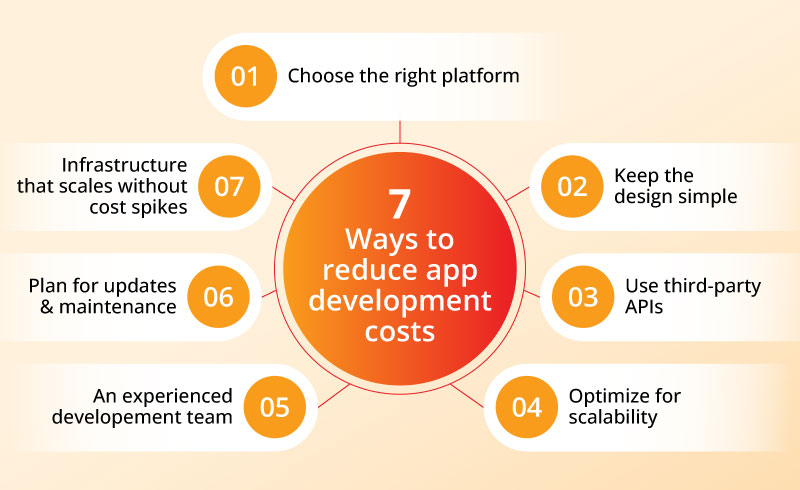
- Choose the right platform: Developing multiple platforms can increase development time and costs. Consider your target audience and the nature of your app to determine which platform to prioritize. Building a cross-platform app using tools like React Native or Flutter can be more cost-effective, as they let you reach a wider audience with a single codebase.
- Keep the design simple: While it’s important to create an attractive and engaging design, adding too many complex design elements can increase development time and costs. Focus on a simple, clean design that still meets your target audience’s needs. Use pre-built design templates or hire a designer with experience creating simple designs to save time and money.
- Use third-party APIs: Instead of building custom solutions for every feature, consider using third-party APIs or services. These can help you save time and money on development while still providing robust functionality. Research and evaluate third-party solutions to ensure they meet your needs, are well-documented, and have a strong developer community for ongoing support.
- Optimize for scalability: Design your app with scalability in mind. Building an app that can easily scale to handle more users and features will save you money in the long run by reducing the need for major rewrites or updates. Use scalable technologies and infrastructure, like cloud-based solutions 또는 microservices architecture, to help your app grow over time.
- Work with an experienced development team: Experienced developers can provide valuable insights and guidance to reduce development costs without sacrificing quality. Look for a team with a proven track record of building successful apps within your budget. Consider working with a development partner who can provide end-to-end services, from design to maintenance and updates, to save time and money.
- Plan for updates and maintenance: Building an app is just the first step. You’ll also need to plan for ongoing updates and maintenance to keep your app running smoothly. Use a modular development approach, where individual features can be updated or replaced without affecting the entire app, to make future updates more cost-effective. Consider building in-house expertise or working with a development partner who can provide ongoing support at a reasonable cost.
- Choose infrastructure that scales without cost spikes: Select infrastructure that can grow with your application without requiring costly migrations or extensive rearchitecting as usage increases. Managed cloud services and DBaaS platforms can automate tasks such as scaling, backups, monitoring, and software updates. This will reduce operational overhead and help avoid unexpected infrastructure costs as your user base grows.
Read more about different ways to reduce the cost of products and services for modern apps.
How much will your app cost? A final summary
App development costs become much easier to estimate when you break the project into a few key decisions.
1. Define the type of app – Start by identifying whether you’re building a simple utility app, an e-commerce app, a social platform, an AI-powered application, or an enterprise-grade system. This establishes the baseline cost range and development timeline.
2. List your must-have features – Features such as user accounts, payments, messaging, real-time updates, AI capabilities, integrations, and admin dashboards are often the largest cost drivers.
3. Choose your platform and infrastructure – Decide whether you need iOS, Android, cross-platform, web, or AI functionality, and determine whether you’ll use managed cloud services/DBaaS or self-managed infrastructure. These choices affect both upfront development costs and long-term maintenance costs.
4. Select your development model – Compare in-house teams, freelancers, agencies, onshore, nearshore, and offshore options. Consider not only hourly rates but also communication, time zone overlap, project management overhead, and expected quality.
5. Validate your estimate with app cost calculators – Use tools such as Inoxoft, Buildfire, and Litslink to generate a feature-based estimate, then use AWS, Azure, or GCP cloud calculators to estimate hosting and infrastructure costs. Finally, add 15–20% of the development budget per year for maintenance, updates, support, and scaling.
Quick rule of thumb
- Simple app: $10,000-$100,000+
- Business or consumer app: $100,000-$500,000+
- Enterprise or AI-heavy app: $500,000-$2M+
Many successful projects start with a minimum viable product (MVP) in the $50,000-$250,000 range, validate market demand, and then expand features over time. Combining a clear scope with the app cost calculators above will usually give you a far more accurate estimate than relying on industry averages alone.
App development cost FAQs
How much does a mobile app developer license cost? An Apple Developer Program license costs $99 per year for individuals and companies, while the Google Play Developer account requires a one-time $25 fee. Microsoft charges $99 for companies, while individuals can now register for free. Other platforms like Amazon Appstore, Samsung Galaxy Store, and Huawei AppGallery offer free developer registration.
How much does it cost to develop an Android app? The cost to develop an Android app ranges from $40,000 to over $300,000, depending on the app’s complexity, features, design, and development team location.
How much does app development cost in India? The cost to develop an app in India ranges from $5,000 to $100,000+, depending on the app’s complexity, features, and development team expertise.
How much does it cost to build an app prototype? The cost to build an app prototype typically ranges from $2,000 to $20,000, depending on design complexity, interactive features, and development approach. A basic clickable wireframe may cost $2,000-$5,000, while a more functional prototype with animations and user interactions can cost more than $10,000.
How much does it cost to build a web app? The cost to build a web app depends on its functionality and complexity. A simple informational website or business portal typically costs $10,000 to $40,000, while a full-stack web application with user accounts, databases, APIs, and third-party integrations generally ranges from $50,000 to $250,000. Enterprise web applications with advanced workflows, security, and high scalability can cost $250,000 to well over $1 million.
What factors affect app development cost the most? The biggest cost drivers are the app’s complexity, feature set, backend infrastructure, third-party integrations, security requirements, AI capabilities, and the development team’s experience and location. You should also include long-term expenses such as cloud infrastructure, maintenance, updates, and customer support in your total cost of ownership estimate.
How much does custom app development cost? Custom app development typically costs more than building an app from a pre-built template because every feature, workflow, and integration is designed specifically for your business. While template-based apps may cost under $50,000 for basic use cases, fully custom applications generally range from $100,000 to $500,000 or more, with enterprise applications often exceeding $1 million.
How long does it take to build an app, and how does that affect cost? Most production-ready apps take 4 to 12 months to develop, while highly complex or enterprise applications can require 12 to 18 months or longer. Longer development timelines typically increase costs because they require more engineering, design, testing, project management, and infrastructure resources throughout the software development lifecycle.
What’s the cheapest way to develop an app? The most cost-effective approach is to build a minimum viable product (MVP) that focuses on the core features users need most. Using cross-platform frameworks such as React Native or Flutter, leveraging third-party APIs, and choosing managed cloud infrastructure or a DBaaS can reduce both development effort and long-term operational costs while making it easier to scale as your application grows.
How much does enterprise app development cost? Enterprise app development typically starts at around $500,000 and can exceed $2 million for applications requiring advanced security, regulatory compliance, real-time data processing, AI capabilities, or integration with existing enterprise systems. The final cost depends on the number of users, business workflows, infrastructure requirements, and the complexity of the application’s architecture.
작가

1개의 응답
-
Nice blog

댓글 남기기
댓글을 달기 위해서는 로그인해야합니다.