

Transactions are an essential part of applications. Without them, it would be impossible to maintain data consistency.
One of the most powerful types of transactions is called a Two-Phase Commit, which is in summary when the commit of a first transactions depends on the completion of a second. It is useful especially when you have to update multiples entities at the same time, like confirming an order and updating the stock at once.
However, when you are performing Microservices orchestration, for example, things get more complicated. Each service is a system apart with its own database, and you no longer can leverage the simplicity of local two-phase-commits to maintain the consistency of your whole system.
When you lose this ability, RDBMS becomes quite a bad choice for storage, as you could accomplish the same “single entity atomic transaction” but dozens of times faster by just using a NoSQL 데이터베이스 like Couchbase. That is why the majority of companies working with microservices are also using NoSQL.
To exemplify this problem, consider the following high-level Microservices architecture of an e-commerce system:
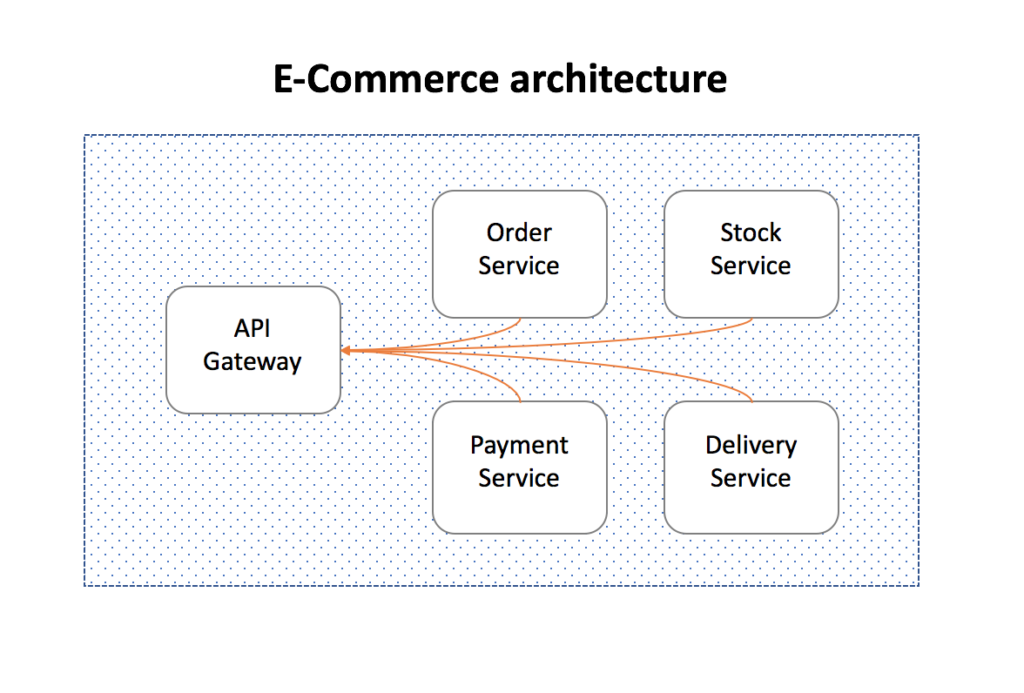
In the example above, one can’t just place an order, charge the customer, update the stock and send it to delivery all in a single ACID transaction. To execute this entire flow consistently, you would be required to create a distributed transaction.
We all know how difficult is to implement anything distributed, and transactions, unfortunately, are not an exception. Dealing with transient states, eventual consistency between services, isolations, and rollbacks are scenarios that should be considered during the design phase.
Fortunately, we already came up with some good patterns for it as we have been implementing distributed transactions for over 20 years now. The one that I would like to talk about today is called Saga pattern.
The SAGA Pattern
A saga pattern is a sequence of local transactions where each transaction updates data within a single service. The first transaction in a saga is initiated by an external request corresponding to the system operation, and then each subsequent step is triggered by the completion of the previous one.
One of the most well-known patterns for distributed transactions is called Saga. The first paper about it was published back in 1987 and sagas have been a popular solution since then.
Using our previous e-commerce example, in a very high-level design a saga pattern implementation would look like the following:
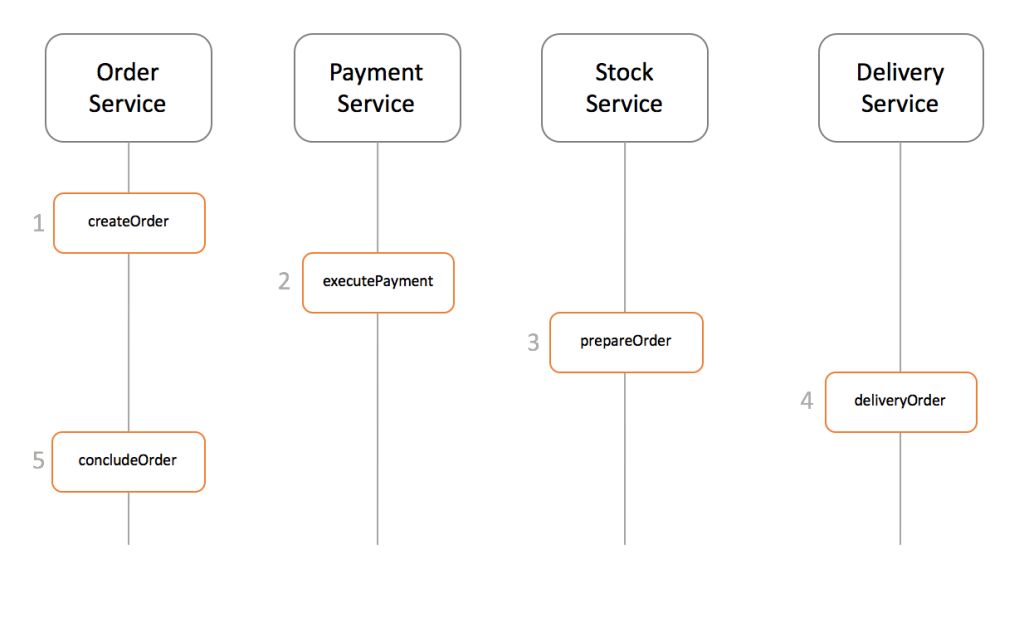
There are a couple of different ways to implement a saga transaction, but the two most popular are:
- Events/Choreography: When there is no central coordination, each service produces and listen to other service’s events and decides if an action should be taken or not.
- Command/Orchestration: when a coordinator service is responsible for centralizing the saga’s decision making and sequencing business logic
Let’s go a little bit deeper in each implementation to understand how sagas work.
Events/Choreography
In the Events/Choreography approach, the first service executes a transaction and then publishes an event. This event is listened by one or more services which execute local transactions and publish (or not) new events.
The distributed transaction ends when the last service executes its local transaction and does not publish any events or the event published is not heard by any of the saga’s participants.
Let’s see how the saga pattern would look like in our e-commerce example:
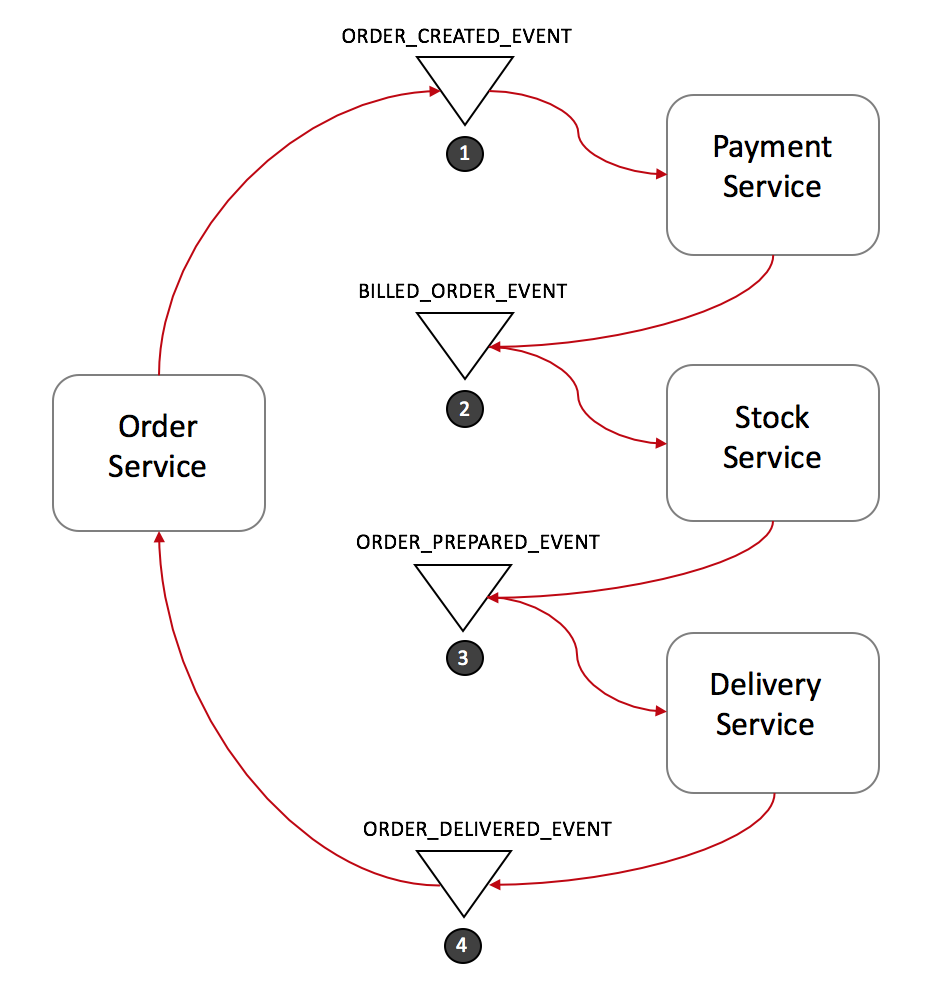
- Order Service saves a new order, set the state as pending and publish an event called ORDER_CREATED_EVENT.
- 그 Payment Service listens to ORDER_CREATED_EVENT, charge the client and publish the event BILLED_ORDER_EVENT.
- 그 Stock Service listens to BILLED_ORDER_EVENT, update the stock, prepare the products bought in the order and publish ORDER_PREPARED_EVENT.
- Delivery Service listens to ORDER_PREPARED_EVENT and then pick up and deliver the product. At the end, it publishes an ORDER_DELIVERED_EVENT
- Finally, Order Service listens to ORDER_DELIVERED_EVENT and set the state of the order as concluded.
In the case above, if the state of the order needs to be tracked, Order Service could simply listen to all events and update its state.
Rollbacks in distributed transactions
Rolling back a distributed transaction does not come for free. Normally you have to implement another compensating transaction for what has been done before.
Suppose that Stock Service has failed during a transaction. Let’s see what the rollback would look like:
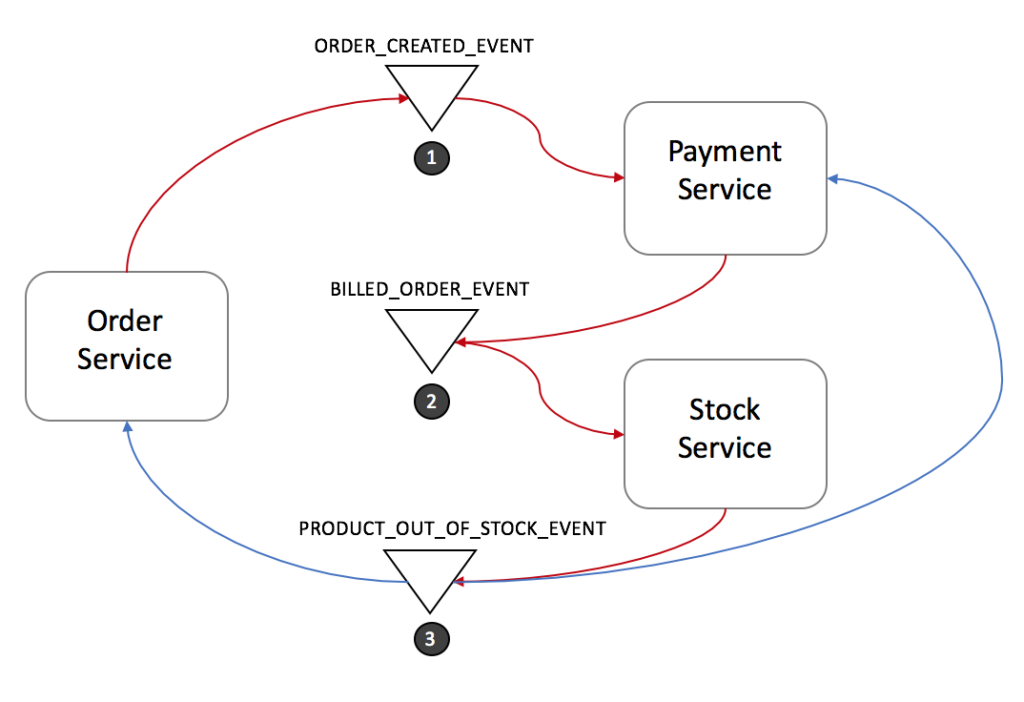
- Stock Service produces PRODUCT_OUT_OF_STOCK_EVENT;
- Both Order Service 그리고 Payment Service listen to the previous message:
- Payment Service refund the client
- Order Service set the order state as failed
Note that it is crucial to define a common shared ID for each transaction, so whenever you throw an event, all listeners can know right away which transaction it refers to.
Benefits and drawbacks of using Saga’s Event/Choreography design pattern
Events/Choreography is a natural way to implement a Saga orchestration pattern. It is simple, easy to understand, does not require much effort to build, and all participants are loosely coupled as they don’t have direct knowledge of each other. If your transaction involves 2 to 4 steps, it might be a very good fit.
However, this approach can rapidly become confusing if you keep adding extra steps in your transaction as it is difficult to track which services listen to which events. Moreover, it also might add a cyclic dependency between services as they have to subscribe to one another’s 이벤트.
Finally, testing would be tricky to implement using this design, in order to simulate the transaction pattern you should have all services running.
In the next post, I will explain how to address most of the problems with the Saga’s Events/Choreography approach using another Saga implementation called Command/Orchestration.
In the meantime, if you have any Saga Design Pattern questions about Microservices, the Saga architecture, or Saga applications feel free to ask me at @deniswsrosa
작가

2개의 응답
-
Two questions about how this might best work with Couchbase.
First, for any storage that doesn’t have multi-document ACID transactions… As far as I can tell, the saga pattern assumes that each service call corresponds to a single database transaction that can commit or roll back. But what if I have a service call that writes multiple Couchbase documents? Does this imply modeling each document write as a distinct event?
Second, specific to couchbase, what if we are also using couchbase lite? A mobile client might perform a downstream sync in the middle of a saga transaction, which might then roll back, and the client probably doesn’t participate in the event stream. I guess we can just assume that the client will eventually catch up to the state of the couchbase server and have to handle any conflicts that arise. What about upstream sync though?
-
[…] saga pattern is a sequence of local transactions where each transaction updates data within a single service. […]

댓글 남기기
댓글을 달기 위해서는 로그인해야합니다.