

Amazon Web Services introduced Serverless Application Model, or SAM, a couple of months ago. It defines simplified syntax for expressing
serverless resources. SAM extends AWS CloudFormation to add support for API Gateway, AWS Lambda and Amazon DynamoDB. This blog will show how to create a simple microservice using
SAM. Of course, we’ll use 카우치베이스 instead of DynamoDB! This blog will also use the basic concepts explained in Microservice using AWS API Gateway, AWS Lambda and Couchbase. SAM
will show the ease with which the entire stack for microservice can be deployed and managed.
As a refresher, here are key components in the architecture:

- Client could be curl, AWS CLI/Console, Postman client or any other tool/API that can invoke a REST endpoint.
- AWS API Gateway is used to provision APIs. The top level resource is available at path
/books. HTTPGET그리고POSTmethods are published for the resource. - Each API triggers a Lambda function. Two Lambda functions are created,
book-listfunction for listing all the books available andbook-createfunction to create a new book. - Couchbase is used as a persistence store in EC2. All the JSON documents are stored and retrieved from this database.
Other blogs on serverless:
- Microservice using AWS API Gateway, AWS Lambda and Couchbase
- AWS IoT 버튼, 람다, 카우치베이스
- Serverless FaaS with Lambda and Java
Let’s get started!
Serverless Application Model (SAM) Template
An AWS CloudFormation template with serverless resources conforming to the AWS SAM model is referred to as a SAM file or template. It is deployed
as a CloudFormation stack. Let’s take a look at our SAM template: This template is available at github.com/arun-gupta/serverless/blob/master/aws/microservice/template.yml.
|
1 2 3 4 5 6 7 8 9 10 11 12 13 14 15 16 17 18 19 20 21 22 23 24 25 26 27 28 29 30 31 32 33 34 35 36 37 38 39 40 |
AWSTemplateFormatVersion : ‘2010-09-09’ Transform: AWS::Serverless-2016-10-31 Description: Microservice using API Gateway, Lambda 그리고 카우치베이스 자원: MicroserviceGetAllGateway: 입력: AWS::Serverless::Function 속성: Handler: org.sample.serverless.aws.couchbase.gateway.BucketGetAll Runtime: java8 CodeUri: s3://serverless-microservice/microservice-http-endpoint-1.0-SNAPSHOT.jar Timeout: 30 MemorySize: 1024 Environment: Variables: COUCHBASE_HOST: ec2-35-163-21-104.us-west-2.compute.amazonaws.com Role: arn:aws:iam::598307997273:role/microserviceRole Events: GetResource: 입력: Api 속성: Path: /books Method: get MicroservicePostGateway: 입력: AWS::Serverless::Function 속성: Handler: org.sample.serverless.aws.couchbase.gateway.BucketPost Runtime: java8 CodeUri: s3://serverless-microservice/microservice-http-endpoint-1.0-SNAPSHOT.jar Timeout: 30 MemorySize: 1024 Environment: Variables: COUCHBASE_HOST: ec2-35-163-21-104.us-west-2.compute.amazonaws.com Role: arn:aws:iam::598307997273:role/microserviceRole Events: GetResource: 입력: Api 속성: Path: /books Method: post |
SAM template Specification provide complete details about contents in the template. The key parts of the template are:
- Defines two resources, both of Lambda Function type identified by
AWS::Serverless::Functionattribute. Name of the Lambda function is defined byResources.. - Class for each handler is defined by the value of
Resources..Properties.Handlerattribute - Java 8 runtime is used to run the Function defined by
Resources..Properties.Runtimeattribute - Code for the class is uploaded to an S3 bucket, in our case to
s3://serverless-microservice/microservice-http-endpoint-1.0-SNAPSHOT.jar Resources..Properties.Environment.Variables.COUCHBASE_HOSTattribute value defines the host where Couchbase is running. This can be easily deployed on EC2 as explained at Setup Couchbase.- Each Lambda function is triggered by an API. It is deployed using AWS API Gateway. The path is defined by
Events.GetResource.Properties.Path. HTTP method is defined usingEvents.GetResource.Properties.Methodattribute.
Java Application
The Java application that contains the Lambda functions is at github.com/arun-gupta/serverless/tree/master/aws/microservice/microservice-http-endpoint.
Lambda function that is triggered by HTTP GET method is shown:
|
1 2 3 4 5 6 7 8 9 10 11 12 13 14 15 16 17 18 |
공공의 클래스 BucketGetAll 구현한다 RequestHandler<GatewayRequest, GatewayResponse< { @Override 공공의 GatewayResponse handleRequest(GatewayRequest 요청, Context context) { 시도하다 { N1qlQuery 질의 = N1qlQuery .simple(선택(“*”) .에서(i(CouchbaseUtil.getBucketName())) .limit(10)); 문자열 결과 = CouchbaseUtil.getBucket().질의(질의).allRows().문자열로변환(); 반환 새로운 GatewayResponse(200, 결과, GatewayResponse.HEADERS_JSON); } catch (ConfigurationException e) { 반환 새로운 GatewayResponse(400, e.getMessage(), GatewayResponse.HEADERS_TEXT); } } } |
A little bit of explanation:
- Each Lambda function needs to implement the interface
com.amazonaws.services.lambda.runtime.RequestHandler. - API Gateway and Lambda integration require a specific input format 그리고 output format.
These formats are defined asGatewayRequest그리고GatewayResponseclasses. - Function logic uses Couchbase Java SDK to query the Couchbase database. N1QL query is used to query
the database. The results and exception are then wrapped inGatewayRequest그리고GatewayResponse.
Lambda function triggered by HTTP POST method is pretty straightforward as well:
|
1 2 3 4 5 6 7 8 9 10 11 12 13 |
공공의 클래스 BucketPost 구현한다 RequestHandler<GatewayRequest, GatewayResponse< { @Override 공공의 GatewayResponse handleRequest(GatewayRequest 요청, Context context) { 시도하다 { JsonDocument document = CouchbaseUtil.getBucket().업서트(Book.fromStringToJson(요청.getBody())); 반환 새로운 GatewayResponse(200, document.콘텐츠().문자열로변환(), GatewayResponse.HEADERS_JSON); } catch (Exception ex) { 반환 새로운 GatewayResponse(400, ex.getMessage(), GatewayResponse.HEADERS_TEXT); } } } |
A bit of explanation:
- Incoming request payload is retrieved from
GatewayRequest - Document inserted in Couchbase is returned as response.
- Like the previous method, Function logic uses Couchbase Java SDK to query the Couchbase database. The results and exception are then
wrapped inGatewayRequest그리고GatewayResponse.
Build the Java application as:
|
1 |
mvn –f microservice–http–endpoint/pom.xml clean 패키지 |
Upload Lambda Function to S3
SAM template reads the code from an S3 bucket. Let’s create a S3 bucket:
|
1 |
aws S3 mb S3://serverless-microservice –region us-west-2 |
us-west-2 region is one of the supported regions for API Gateway. S3 bucket names are globally unique but their location is region specific. Upload
the code to S3 bucket:
|
1 |
aws S3 cp microservice–http–endpoint/목표/microservice–http–endpoint–1.0–SNAPSHOT.jar S3://serverless-microservice/microservice-http-endpoint-1.0-SNAPSHOT.jar |
The code is now uploaded to S3 bucket. SAM template is ready to be deployed!
Deploy SAM Template
Deploy the SAM template:
|
1 2 3 4 |
aws cloudformation deploy —template–파일 template.yml —stack–이름 microservice–gateway —지역 us–west–2 |
It shows the output:
|
1 2 3 |
Waiting ~를 위해 changeset -로 있다 created.. Waiting ~를 위해 stack 만들다/업데이트 -로 완료 Successfully created/updated stack – microservice–gateway |
This one command deploys Lambda functions and REST Resource/APIs that trigger these Lambda functions.
Invoke the Microservice
API Gateway publishes a REST API that can be invoked by curl, wget, AWS CLI/Console, Postman or any other app that can call a REST API. This blog will use AWS Console to show the interaction. API Gateway home at us-west-2.console.aws.amazon.com/apigateway/home?region=us-west-2#/apis shows:
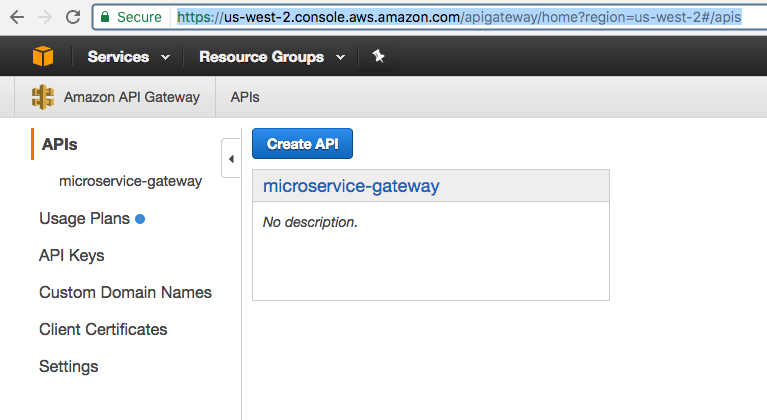
Click on the API to see all the APIs in this resource:
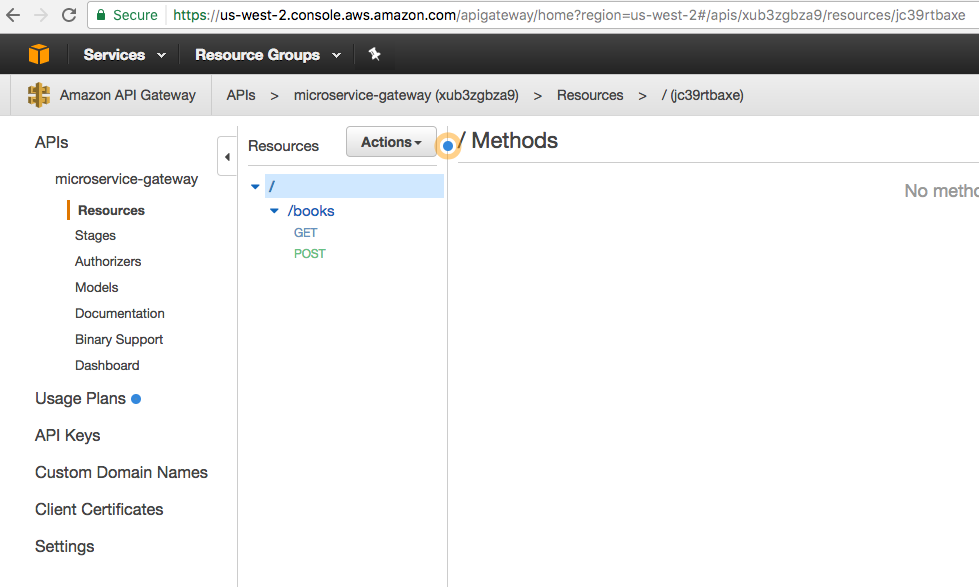
Click on POST to see the default page for POST method execution:
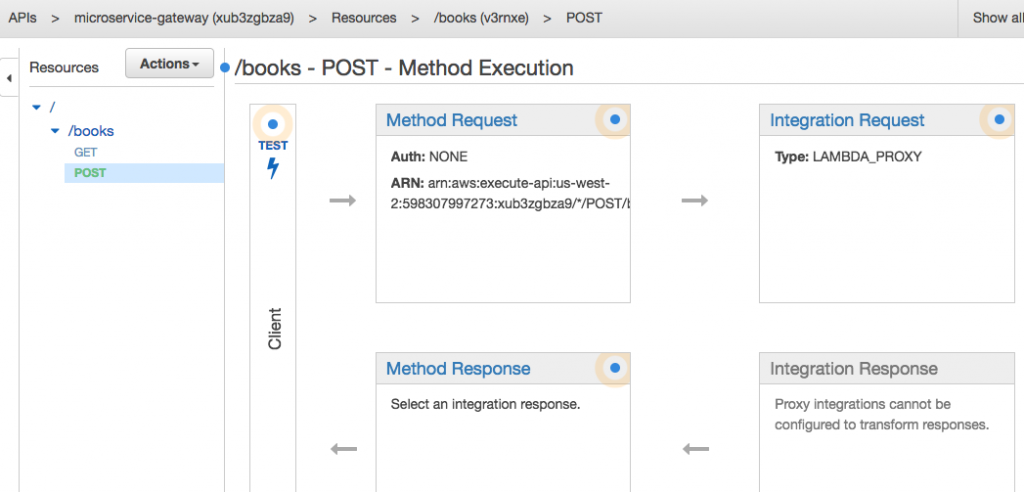
Click on Test to test the API:
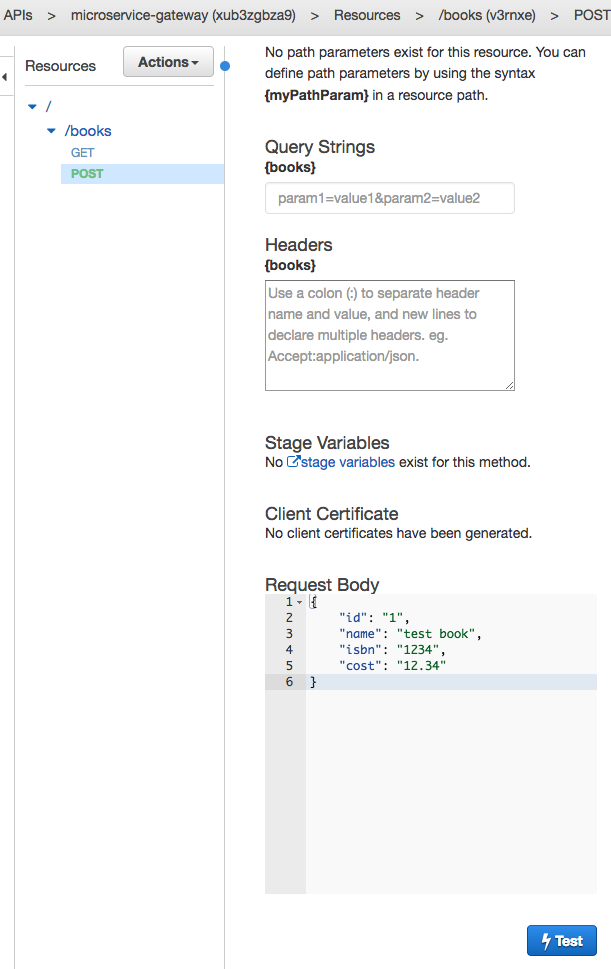
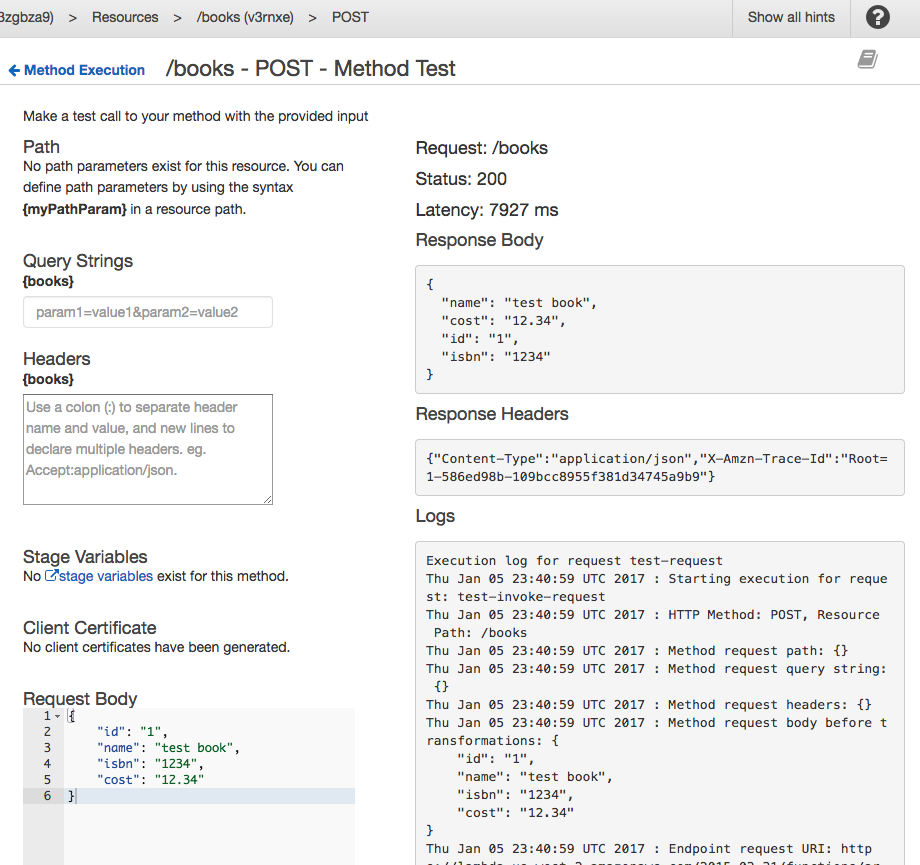
Add the payload in Request Body and click on Test to invoke the API. The results are shown as below:
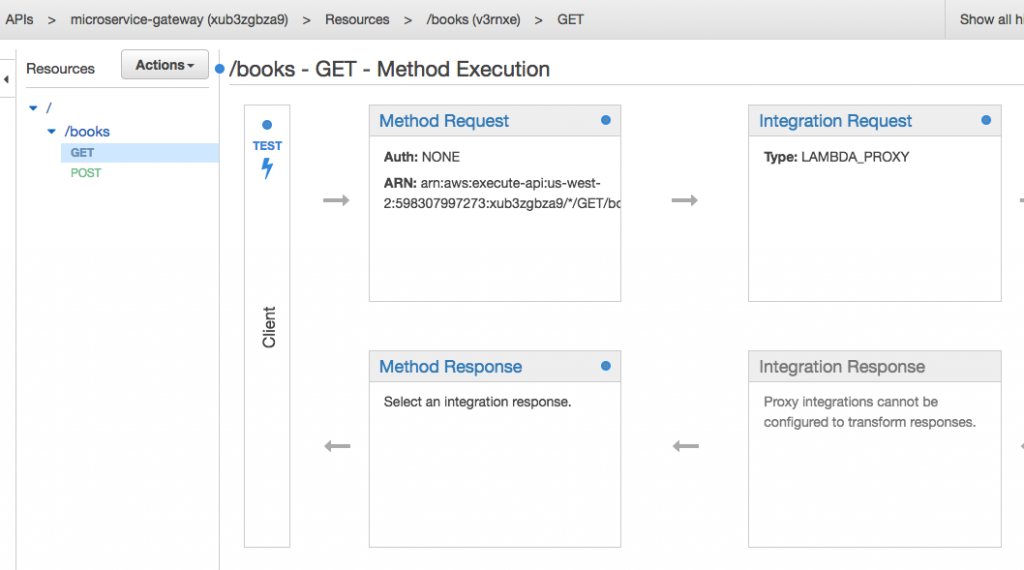
Now click on GET to see the default execution page:
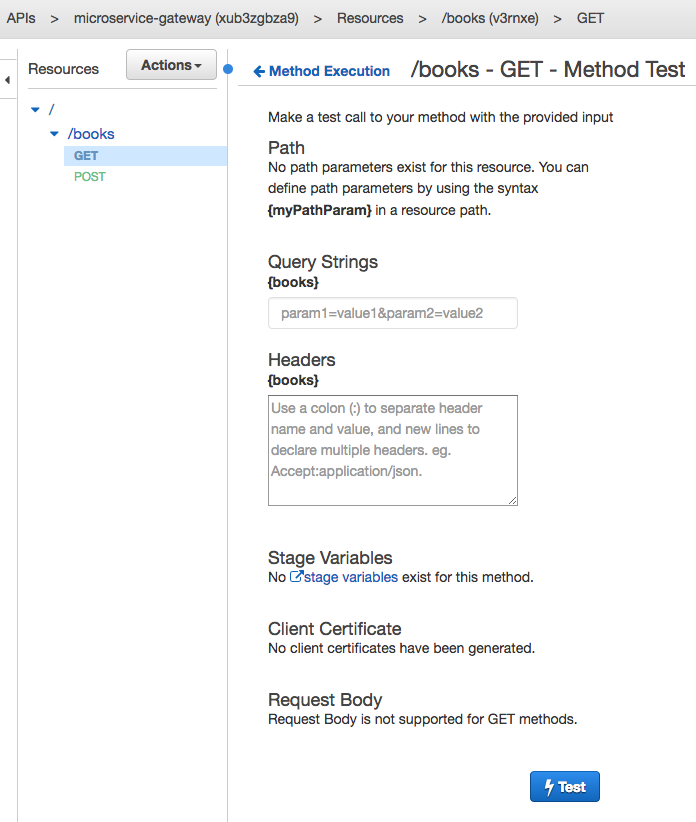
Click on Test to test the API:
No request body is needed, just click on Test the invoke the API. The results are as shown:
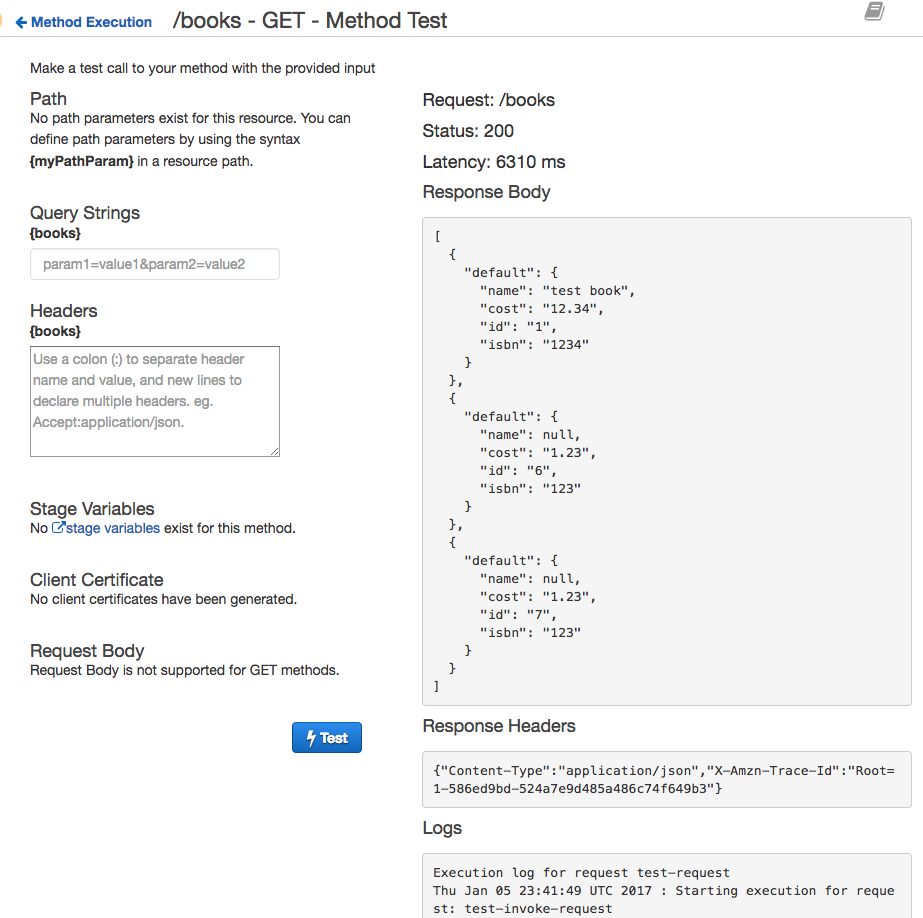
Output from the Couchbase database is shown in the Response Body.

댓글 남기기
댓글을 달기 위해서는 로그인해야합니다.